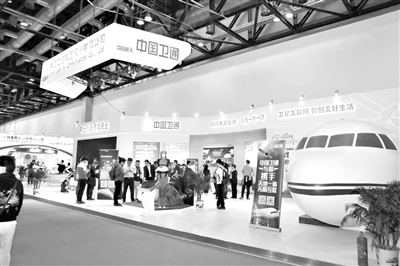
Photo courtesy of China Weitong
On June 9, 2008, Zhongxing-9 was lifted by the Long March-3 B rocket and became the first real dedicated TV direct broadcast satellite in China. It has been more than 11 years since this flight. In the past 11 years, China’s first generation direct broadcast satellite space segment system has grown from scratch, serving 140 million users, effectively bridging the digital divide and enabling sustainable development.
Constructing the Space Segment System of the First Generation Direct Broadcasting Satellite in China
In the 1980s and 1990s, the demand for radio and television services increased sharply in all walks of life, and the demonstration of direct broadcast satellite system was accelerated in China. In 2000, the project of direct broadcast of radio and television satellite was included in the high-tech project in the tenth five-year plan of the country. In January, 2005, with the support of the former State Administration of Radio, Film and Television, the scheme of the same orbit, the same frequency band, the same capacity and the same coverage for Xinnuo-2 and Zhongxing-9 satellites was adopted. At the same time, the space segment system of China’s first-generation satellite live broadcast was approved by the National Development and Reform Commission and started to be implemented, and China Weitong was responsible for the specific management and operation.
Looking back 11 years ago, Jiang Longcheng, who was then in charge of the payload of China Satcom Zhongxing No.9, was filled with emotion: "I have been with it from preliminary design, key design to supervision." Zhongxing 9 is like a daughter in her own boudoir.
According to Jiang Longcheng, the live broadcast satellite system has the advantages of wide coverage, high transmission quality, low receiving cost and convenient maintenance. China has a vast territory, complex terrain and a large population. Direct broadcast satellite is the most effective means to realize the listening and watching of radio and television in the old, young, marginal, poor and vast rural areas.
Different from other satellites, the direct broadcast satellite needs repeated coverage optimization design to effectively cover the whole territory of China. However, for the first time, a high-power amplifier was used in Zhongxing No.9, and its effective radiation power met the requirements of China direct broadcast satellite system, which enabled more than 97% of the residents in China to directly receive satellite radio and television programs from China using a 0.45-meter small-aperture antenna.
As the confident Jiang Longcheng expected, less than one month after the launch, on July 5, Zhongxing 9 opened four transponders to transmit 45 sets of TVs and 43 broadcasts, and entered the trial operation stage; On August 6th, nearly 7,000 satellite TV receivers in Xizang were transferred from Asia-Pacific IIR to Zhongxing 9, marking the official opening of the direct broadcast satellite service in China. In the same month, the coverage of Zhongxing 9 was tested on the spot, and 27 test sites including Altay, Xisha, Mohe and Pulan were selected. The results showed that Zhongxing 9 had good performance.
In 2013, in order to ensure the safe broadcast of the live satellite service, avoid the systematic risk of the operation of Zhongxing 9 Lone Star and ensure the safe broadcast of radio and television programs watched by hundreds of millions of people, China Satellite Communication restarted the construction of Zhongxing 9A (Xinnuo 2 replacement star). Zhongxing 9A also added the South China Sea beam, which solved the problem that it is difficult for military and civilians in the South China Sea to watch TV. On June 19, 2017, the domestic broadcast live star Zhongxing 9A was launched, and then it undertook the task of safe backup of Zhongxing 9 live star.
Serving 140 million users to bridge the digital divide
A few hundred meters away from xichang satellite launch center, in the depths of Daliangshan Mountain, is Mayelin Village where Yi people live together. Although it is only a few hundred meters away, the members of the Zhongxing No.9 test team stationed at the launch site and the villagers in Mayelin Village have very different information acquisition. The experimental team members from big cities know radio, television and internet like the back of their hands, but many villagers who have lived in the deep mountains for generations have only been to Mianning County as far as possible, and there are almost no channels to understand the outside world.
In this way, an invisible digital divide lies in the Great Liangshan Mountain, and the broadcast satellite Zhongxing 9/Zhongxing 9A launched from here provides an effective technical means for narrowing the gap between urban and rural areas, eliminating the digital divide and building information fairness and justice.
Through the live satellite of Zhongxing-9 and Zhongxing-9A, a "pot" for receiving satellite signals to the outside world was set up on the roofs of remote villages in Daliangshan. The people in rural Xizang witnessed the grand occasion of the Beijing Olympic Games that year, and more compatriots in remote areas were able to hear and see the care and voice of the CPC Central Committee for the first time.
The direct broadcast satellite "every village is connected" and "every household is connected" projects have effectively covered 595,000 administrative villages, meeting the needs of 140 million users to listen to and watch radio and television programs, exceeding one third of the total number of radio and television users in China. The problem of "difficult, expensive and poor" coverage of rural radio and television in China has been fundamentally solved, and the quality, level and viewing effect of rural radio and television coverage have been greatly improved.
Up to now, rural users in China can listen to and watch 17 sets of central radio programs, 17 sets of central TV programs, 27 sets of provincial radio programs and 41 sets of provincial TV programs through Zhongxing 9 satellite, and Xinjiang, Xizang, Ningxia, Inner Mongolia, Guizhou and Hainan have achieved satellite transmission and directional coverage of programs in their own provinces (regions) or cities.
Beginning in 2018, the dual-star backup of central radio and television programs and minority language programs will be gradually realized through China Satellite 9A. At the same time, the South China Sea beam on the satellite will be used to provide radio and television programs of the central and some coastal provinces to the people in the South China Sea.
Promote model innovation and empower sustainable development.
In recent years, the direct broadcast satellite system has explored new focal points and ways to achieve radio and television services to the overall national work and meet the people’s beautiful spiritual and cultural needs, focusing on the positive actions of building a well-off society in an all-round way, accurately helping the poor, revitalizing the countryside and enriching the people, and has also played a very good role in helping the poor and helping the wisdom and improving the level of rural civilization.
Facing the first generation live broadcast satellite system that has been in operation for 11 years, starting the replacement satellite project is the next task of China Satcom. In addition, the innovative exploration of direct broadcast satellite business model is also a topic.
Although the direct broadcast satellite has greatly improved the radio and television public service in remote rural areas, under the situation that the number of users of direct broadcast satellite service has increased rapidly year by year, the transponder rental rate has improved, but the high-quality transponder resources have not been fully utilized.
Jiang Longcheng, who is now the technical director of China Satcom Business Operation Center, has taken a longer-term view of the direct broadcast satellite business that he has devoted half his life to. He hopes to increase the use of direct broadcast satellites, especially promote the business application in key areas, accelerate the implementation of the value-added business plan, and tap the value of many users in various directions.
"For live broadcast satellites, only by giving full play to their excellent performance and benefits can we meet the needs of the people for radio and television services more widely, which is also the direction that live broadcast satellites should work hard in the future." Jiang Longcheng said. (Hu Wei Wu Lin)