The IP of Buddhist animals is on fire. How can the net stalk become "real money"?
Text | Lei Bao Duan Qing
Edit | Nur Hachi
A lot of animal IP have been fired this year. Among them, the capybara can be described as a well-deserved "top stream", and related videos and surrounding areas have already exploded the major social platforms in China.
In recent years, terms such as "lying flat", "anti-involution", "slow life" and "emotional stability" have become popular among young people. The capybara, a creature, has been warmly sought after by virtue of its "calm and absurd" mental state. It has an enviable "sense of relaxation" and can take it in stride no matter what happens. Birds, cats and dogs, turtles and even crocodiles can coexist harmoniously with it.
In addition, there are net stalks such as "Smith?" and "Rat, Mouse and Me", which bring fire to animals such as monkeys and mice, which are not popular. They are widely spread because they can represent the mental state of young people.
In the high-pressure and fast-paced life, many young people have become loyal followers of "Dolphin Gate", which has also attracted more and more brand attention, tapped the commercial value of these "spiritual idols", created animal IP-related surroundings, and attracted consumers to pay.
So, why did the "Dolphin Gate" rise? How does the animal IP derived from epidemic stalks evolve? What commercial realization attempts have the brand made?
How are the "Capibala" popular?
In the eyes of the elders, capybara, monkey and mouse, which are admired by young people, seem to be in a strange fire.
For capybara, at first, it was just a niche animal that would appear in popular science videos. Its earliest memory on the Internet can be traced back to 2010, when a video of a capybara bathing in an orange spread on Youtube. This video didn’t really make it a online celebrity, but slowly enriched its own "dolphin design" through popular science.
Until this year, a blogger moved the popular song "Capybara" from the internet to the Tik Tok platform, and cooperated with the video created by the capybara, which began to spread widely on the Internet. The related words of "dolphin gate" emerged, and "Capybara" became synonymous with capybara.
Subsequently, the official operation of Xiaohongshu launched the topic of "One Dolphin a Day" to lead young people to join the "Dolphin Gate"; More merchants began to collect peripheral design schemes and launch products in Xiaohongshu.
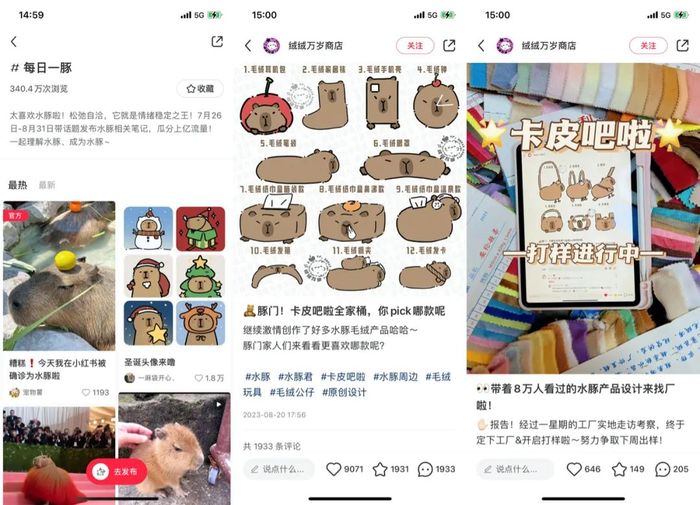
It can be said that the capybara is based on its cute appearance, catching young people by relying on "emotional stability" and "relaxation", and finally relying on platform traffic to officially push the heat to a climax and realize rapid commercialization.
The monkey "Malou" also originated from the popular terrier. During the Spring Festival in 2022, Guangxi merchants could not resist the voice of netizens urging the listing of sugar oranges, and they all said that "Moluo’s life is also life". As a result, the humble "Molou", which represents migrant workers and college students, has become a "substitute" for young people to oppose involution and vent their pressure.
"Mouse, mouse and me" originally came from the lines of netizens poking fun at celebrities, but what really made this stalk fire was the "mouse man" expression pack derived from it, which also released the emotions and pressure of "bottom workers".
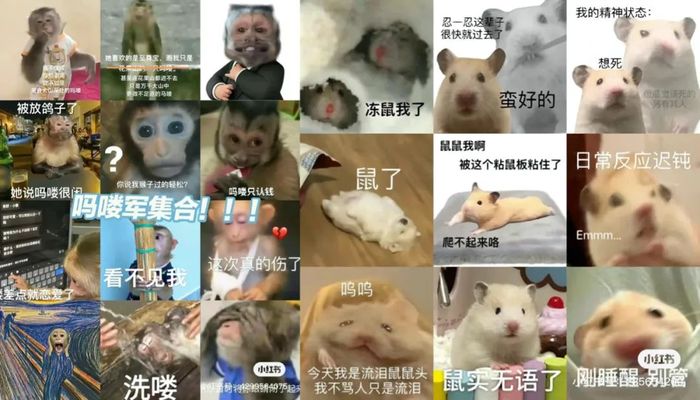
It is not difficult to see that the animal IP born from these netted stems has gone through the process from cognition, identification to resonance among young people. So how can these animals be very popular, occupy the life circle of young people, and even attract them to pay willingly?
First of all, it is an alternative way for young people to express themselves. When people are too tired, young people begin to turn into "spiritual animals". Faced with the pressure of life, they express their sense of resistance by laughing at themselves, while expecting to accept everything emotionally and lay flat like a capybara, but retaining hope for life.
Secondly, this is the projection of young people’s anxiety under the "anti-involution" culture. Or cute or funny animals, with a unique sense of humor, resonate with young people’s inner anxiety and struggle.

At the same time, it is also an emotional outlet for young people. It can let them let go of their burdens, freely vent and export their emotions, reconcile with their own "ordinary", unload their decent camouflage, return to the most primitive animal instinct, and get a moment’s respite.
On this basis, as long as we grasp some characteristics of animals and combine the Internet traffic to amplify their emotional resonance with consumers, such as the "emotional stability" of capybara, the "humble" and "rotten" of Moluo, similar to the explosion of animal IP, it is actually completely possible to achieve re-engraving.
Why did "Capibala" evolve from net stalks to "real money"
After these animals’ IP is abstracted as the symbol of "spiritual stability" and "lying flat", people’s love for them is no longer limited to video, graphic and other creative forms, and the related willingness to pay is increasing day by day, and the surrounding business represented by "Capibala" is booming. Up to now, the number of views on the topic "around capybara" in Xiaohongshu has reached 10 million.
As a category with low threshold and mature supply chain, plush’s commercial value is first valued.
On the one hand, it can fully restore the plush feeling of animal IP itself, so that young people can meet with "spiritual idols" at a little cost; On the other hand, as a typical representative of the healing economy, plush toys have officially become a major category of the 100 billion-wave playing track, and the market of "plush +IP" is also accelerating.
The first to take this step is a new brand "Long live the velvet shop", and capybara is the second plush product of this brand. In August this year, Viva Velvet Store announced that it had joined the "Dolphin Gate" and provided a number of plush design schemes, which were developed and put into production in combination with the opinions and feedback of netizens.
Subsequently, Jellycat, a plush top-stream brand, and The Green Party, a domestic chain lifestyle brand, also launched capybara plush toys, which triggered a wave of buying by consumers.
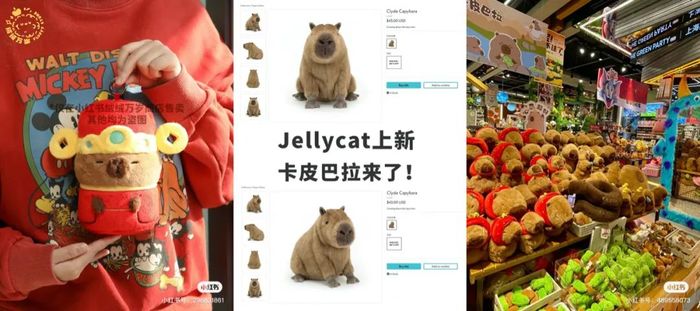
From left to right, there are capybara plush toys from Long Live Furry Store, Jellycat and The Green Party.
The new tea brand that will "follow the fashion" most has also been launched, and a wave of effective marketing has been completed among young people.
Brands such as Starbucks, Ningji, and Yongpu Coffee have launched Capibala related products and surrounding areas; Xicha directly adopted the capybara "Almond" of Nanjing Hongshan Forest Zoo and made an unexpected linkage.
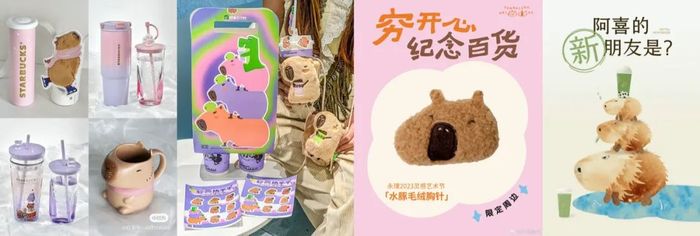
From left to right are the capybara products of Starbucks, Lemon Season, Yongpu Coffee and Xicha.
As mentioned above, it is not a case that this kind of animal IP has gone from fire to rapid commercialization. Penguins from Jellycat, sharks from IKEA, dogs with light IP lines from Korea, Loopy, etc. all use certain characteristics of animals to capture young people, and then drive consumption.
Combined with the case, it is not difficult to see that, first of all, there is still a lot of room for development of unpopular animal IP.
In addition to the common animal images such as cats, dogs, rabbits and bears, the introduction of IP of unpopular animals like capybara and beaver can bring freshness to consumers on the one hand; On the other hand, there are few products related to unpopular animals, and brands can seize the copyright opportunity to some extent by commercializing them.
Secondly, Internet popularity is a natural means to expand the voice volume of this kind of IP.
The threshold of the net stem can be very low, and the volume can also be small, even just a sentence and an expression pack. As long as it can help young people express themselves and vent their emotions, and meet consumers’ emotional needs and social needs, the net stem can have a "viral" diffusion ability.
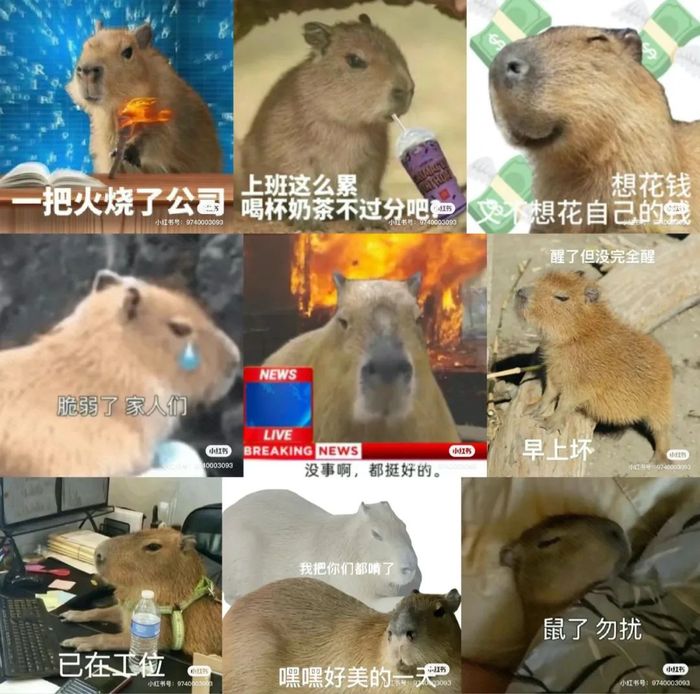
Capibala emoticons created by users of Xiaohongshu
Then, the development of IP characteristics can build a new marketing model.
In the past, brands built IP and authorized cooperation, basically relying on the traffic between brands and IP to borrow from each other to improve exposure. However, under the background of the prevalence of healing economy, relying on IP’s own characteristics to quickly resonate and impress consumers and directly achieve effective customer acquisition is a breakthrough in IP marketing.
Finally, young people have a strong willingness to pay for emotional expression.
This phenomenon can be seen from capybara capybara, or Lei Bao’s previously reported Korean light IP, plush play and MBTI marketing. Under the general trend of consumption degradation, young people’s emotional consumption power is more prominent than before.
Generally speaking, behind this kind of IP destruction, IP is no longer just used as a simple image to ridicule and get cured, but more as a spiritual and cultural symbol and an identity symbol. "Capibala" is the symbol of "self" pursued by young people. On this basis, it can provide users with a sense of identity and belonging in line with their needs, which can further strengthen IP value and brand image.
The trend is always changing with each passing day. Compared with "catching up" with the trend, finding the fundamental logic behind the trend, understanding the real psychological needs of consumers, and then "creating" the trend is something that brands and IP licensees should do for a long time.