Why can’t the threshold for women’s employment be lowered?
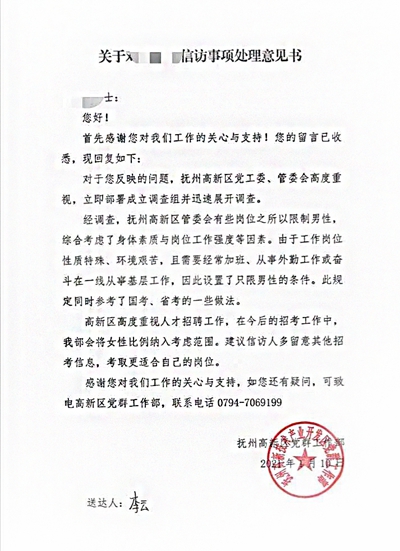
In November, 2020, Jiangxi Fuzhou High-tech Zone publicly recruited the job list of the five-level host staff, which triggered a heated discussion among netizens.
This job list shows that 20 jobs, including comprehensive posts, management posts and comprehensive manuscript posts, of 14 recruitment units including the Party and Government Office, the People’s Social Security Bureau, the Finance Bureau and the Audit Bureau of Fuzhou High-tech Zone are marked with the requirement of "male".
Subsequently, some netizens questioned that such recruitment was suspected of gender discrimination in employment. On January 10th, this year, the Party-mass Work Department of Fuzhou High-tech Zone in Jiangxi responded that the reason why some posts restrict men is that factors such as physical fitness and job intensity are comprehensively considered. Due to the special nature of the post, the harsh environment, and the need to often work overtime, engage in field work or struggle to engage in grass-roots work in the front line, the conditions are set for men only.
Such a "threshold" is not uncommon. According to the Survey Report on the Status of Women’s Workplace in China in 2020 released by a well-known Internet recruitment platform, 27% of women have encountered the situation that "when applying for a job, the employer restricts the gender of the post".
The Party and Mass Work Department of Fuzhou High-tech Zone in Jiangxi responded that this regulation also refers to some practices of national examination and provincial examination. "It is recommended that petitioners pay more attention to other recruitment information and obtain positions that are more suitable for them."
Gender discrimination in employment is especially obvious for female college students.
The reply of Jiangxi Fuzhou High-tech Zone is not without reason.
Previously, in view of the gender-focused recruitment in the national examination, the statistical results of The Paper showed that in 2021, there were 5,776 jobs except for the tax bureau posts with nearly equal gender distribution. Among these positions, 35% are marked with preference for men, 5% are marked with preference for women, and the remaining 60% are not marked with gender preference.
Yuanyuan is a volunteer of Weibo Platform @ Employment Sex Discrimination Monitoring Brigade. After three years as a volunteer, she realized that it is a common phenomenon that employment discrimination against women is subdivided into all walks of life. She believes that if there are some jobs that restrict women from applying for the national examination and provincial examination, the recruitment in other places will also refer to it.
Song Qiang, HR director of a large state-owned enterprise, told the reporter that considering the intensity of construction work and the resistance of women, every year when recruiting on campus, HR often puts forward the requirement of "only male resume" to the employment center. Even if the school provides resumes of some female job seekers, it is unlikely to be selected.
"Basically, about 90% choose men, but there is no denying that some women can also be competent for the job." Song Qiang said frankly.
China’s labor law stipulates that women enjoy equal employment rights with men. When hiring employees, except for jobs or posts that are not suitable for women as stipulated by the state, women shall not be refused employment or the employment standards for women shall be raised on the grounds of gender.
However, the warning function of the law is limited. Lawyer Yang Baoquan, a senior partner of Beijing Bank of China Law Firm, said in an interview with the reporter of Zhongqing Daily and Zhongqing.com that at present, there is still a serious gender discrimination in employment in China. Many employers have exploited legal loopholes, openly stating the requirements only for men in the recruitment conditions, thus directly excluding women from their posts.
Yang Baoquan said that this situation is particularly prominent when female college students are employed.
According to a survey conducted by the Women’s Research Institute of the All-China Women’s Federation in Beijing and other universities in 2015, as many as 86.6% of female college students have suffered from one or more gender discrimination in recruitment, and more than 80% are engineering college students.
Many times, gender requirements have become the first hurdle for women to apply for jobs. @ Employment Sex Discrimination Monitoring Brigade currently has nearly 500,000 fans on Weibo. Every day, some netizens privately trust them with the requirement of "men only" in the recruitment notice of the employer, asking for a report.
Yuanyuan believes that job hunting is a two-way selection process, and the recruiting unit should quantitatively display the dimensions such as work intensity. Job seekers can evaluate according to their own situation, and should not eliminate the whole group on the grounds of gender.
The regulation of protecting women has become a "concern" in recruitment.
In Yang Baoquan’s view, gender discrimination in the workplace is not only manifested in unequal employment opportunities, but also in "self-evident" differences in employment treatment and promotion opportunities. Compared with the explicit discrimination before employment, the latter is more subtle and more difficult to characterize and supervise.
Because enterprises need to pay remuneration and insurance fees and adjust employment arrangements for maternity female employees, they also bear more economic expenses. In order to avoid this kind of economic expenditure, some enterprises do not recruit women directly. These regulations, which were originally for the protection of female employees, have become the "scruples" for enterprises not to recruit women.
This is not without examples. Song Qiang told the reporter of China Youth Daily and China Youth Network that women in their units generally engage in auxiliary work, which not only leads to a lower salary level, but also leads to more tortuous promotion channels. If a woman has a need for marriage and childbirth, the unit often makes countermeasures in all aspects out of consideration of her work energy. "During the 98-day maternity leave of a woman, the unit will train a staff member similar to a substitute for a rainy day."
Subject to the labor law, the employer shall not terminate or terminate the labor contract of female employees during pregnancy, childbirth and lactation. However, according to Song Qiang’s understanding, some enterprises will let employees "voluntarily" ask for resignation, for example, they will be transferred to remote areas or posts, and they will be forced to resign to take care of their families.
These practices are very common in Song Qiang’s view, and many people have fixed stereotypes, such as "women tend to make more efforts in balancing family and work."
"The reproductive cost of women is not socialized for the time being, and enterprises are unwilling to bear more expenses in this respect, which is an important reason for gender discrimination in the workplace." Yuanyuan said.
Before the two sessions in 2020, Yuan Yuan and the volunteer team made suggestions to the NPC deputies: extending paternity leave for men and implementing compulsory maternity leave. In their view, only by increasing the cost paid by men’s families can we improve the unfairness in the workplace and at the same time enhance the sense of responsibility of men’s family parenting.
It is a long way to ensure women’s equal employment.
Some media once searched online for "employment discrimination" in China’s judgment documents, and found that there were 152 related judgments and rulings from 2010 to 2020, of which less than half were based on employment discrimination.
On a social media, an article entitled "When asked to give birth, how to answer to satisfy the interviewer" was forwarded by many netizens. Faced with the seemingly "unsolvable" practical problems, many female job seekers can only choose passive adaptation.
In fact, there are more policies to promote equal employment. In China’s legal system, the provisions on women’s employment focus on protecting women’s equal rights and fair employment rights. For example, the Labor Law, the Employment Promotion Law, and the special provisions on labor protection for female employees all clearly stipulate the legal responsibilities that employers need to bear when they are suspected of gender discrimination in employment.
In February 2019, the Ministry of Human Resources and Social Security and the Ministry of Education issued the Notice of the Ministry of Human Resources and Social Security and the Ministry of Education on Further Regulating Recruitment Behavior to Promote Women’s Employment. Among them, it is required that employers and human resources service agencies that publish recruitment information containing gender discrimination shall be ordered to make corrections according to law; Refuses to correct, at more than 10 thousand yuan to 50 thousand yuan fine; If the circumstances are serious, the service license of human resources will be revoked.
However, in Yang Baoquan’s view, China does not have a perfect anti-employment sex discrimination law so far. At present, the provisions on the issue of gender discrimination in employment are too general, with low applicability and lack of operability in practice. How to report the employer and how to distribute the burden of proof after women encounter gender discrimination are not reflected in our laws.
Yang Baoquan believes that the implementation of the second-child policy will undoubtedly have a further impact on women’s employment. "In the future, the whole country and nation will benefit from the welfare brought by the population policy, and the female group will bear the related negative effects alone, which is contrary to the concept of fairness and justice."
There is still a long way to effectively promote employment equality. Yang Baoquan suggested that on the basis of continuing to improve legislation and birth policy, it is urgent to set up a special equal employment committee to be responsible for the organization, coordination and guidance of anti-employment discrimination.
"With specialized agencies, it is more conducive to ensuring that laws and regulations are implemented." He said.
Zhongqing Daily Zhongqing Net Trainee Reporter Chen Wei Source: China Youth Daily