The Yellow River’s water and sediment regulation has been officially launched, bringing great social, economic and ecological benefits into play.
CCTV News:Today (June 21st) morning, Xiaolangdi Water Control Project, located in the main stream of the Yellow River in Luoyang City, Henan Province, increased its discharge, marking the official start of water and sediment regulation of the Yellow River before the flood season on July 1st this year.
CCTV reporter Chen Xi:I am now at the site of the Xiaolangdi water control project, and the three-hole gate behind me has been opened, and three huge hoses are spewing out. This year, the Yellow River’s water and sediment regulation will last about 20 days, with a total discharge of 5.5 billion cubic meters and a sediment discharge of 80 million tons.
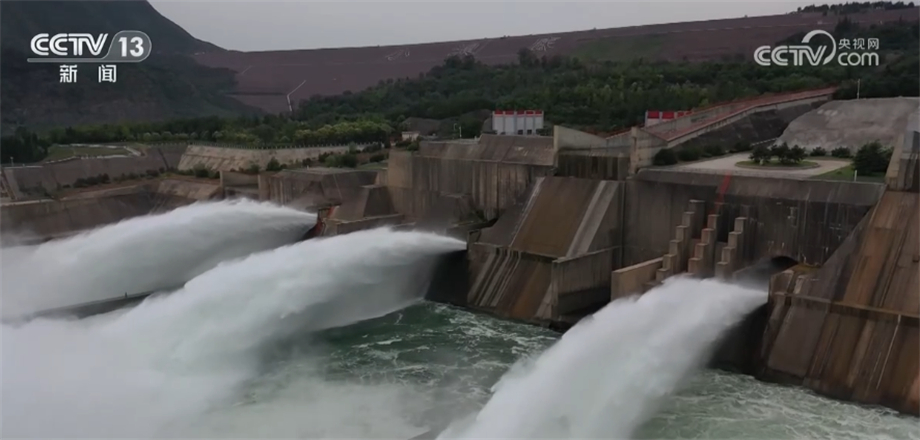
This year’s water and sediment regulation will jointly dispatch Wanjiazhai, Sanmenxia, Xiaolangdi and other reservoirs, concentrate large-flow water to discharge the impact, and send the silt in the reservoirs along the line and the downstream riverbed to the sea, thus increasing the flood discharge capacity of the main channel of the Yellow River. In addition, this year’s water and sediment regulation has increased the dispatching of three tributaries, namely Luhun, Guxian and Hekou Village. These three reservoirs can discharge clear water during the sediment discharge period of Xiaolangdi Reservoir, thus diluting the water with high sediment concentration in the river and reducing the impact on fish.

Yao Wenguang, Director of Flood and Drought Disaster Prevention Department of Ministry of Water Resources:Since 2002, the Yellow River Conservancy Commission of the Ministry of Water Resources has carried out water and sediment regulation for 22 consecutive years. The downstream river channel has been cut down by an average of 3.1 meters, and the flood discharge capacity has increased from 1,800 cubic meters per second to about 5,000 cubic meters per second. At the same time, it has replenished 1.05 billion cubic meters of ecological water for the downstream Yellow River Delta, and the water and sediment regulation sofa has exerted great social, economic and ecological benefits.

The Yellow River has the largest sediment content in the world, with an average annual sediment discharge of about 1.6 billion tons. Implementing water and sediment regulation is one of the key measures to improve the coordination of water and sediment in the Yellow River. Before the flood season this year, the Ministry of Water Resources also previewed the water and sediment regulation scheme with the help of the "Digital Twin Yellow River" project. According to the monitoring, after 22 years of water and sediment regulation, the Yellow River has transported 3.25 billion tons of sediment into the sea, providing a reliable guarantee for ecological management and high-quality development along the Yellow River.
How to adjust the hundreds of millions of tons of sediment in the Yellow River?
According to the water and sediment regulation scheme of the Yellow River before the flood season in 2023, the water and sediment regulation started at 9: 00 on June 21st and lasted for about 20 days. Through the joint operation of several large reservoirs, the total sediment discharge is estimated to be more than 80 million tons. So, how to adjust so much sediment?
Every year before the main flood season of the Yellow River, the Ministry of Water Resources dispatches Wanjiazhai, Sanmenxia and Xiaolangdi reservoirs in the middle reaches of the Yellow River to relay and increase the discharge, forming an "artificial flood peak", so that the rushing river can take away the sediment at the reservoir bottom and the river bottom under the premise of ensuring safety. In the flood season, when the flood magnitude is not large and the sediment content is not high, the Ministry of Water Resources will jointly dispatch the middle and upper reaches of the reservoir in a timely manner, so as to pool the flood process of a certain magnitude and create conditions for the downstream river scouring.

Li Rongrong, Deputy Director, Institute of Hydrology and Sediments, Planning Institute of the Yellow River Survey, Planning and Design Institute:After the start of water and sediment regulation, Xiaolangdi Reservoir discharged a large flow of water, which washed away the sediment in the lower reaches of the Yellow River. When the water level of Xiaolangdi Reservoir discharged to the docking level, Wanjiazhai and Sanmenxia reservoirs were dispatched to discharge water, which impacted the sediment deposited in Xiaolangdi Reservoir. When the sediment-laden flow in the river meets the clear water in the reservoir area, because the density of the former is higher, the sediment-laden flow will sneak into the bottom of the clear water and continue to flow forward, forming a "density flow", and finally discharge the sediment from the dam bottom to achieve the effect of reducing siltation.
Before the flood season this year, the Yellow River Conservancy Committee of the Ministry of Water Resources previewed the water and sediment regulation scheme with the help of the "Digital Twin Yellow River" project, which provided effective assistance for this year’s water and sediment regulation.

Ren Wei, Director of Program Technology Division, Defense Bureau, Yellow River Conservancy Commission, Ministry of Water Resources:Compared with previous years, this year’s water and sediment regulation has further optimized the regulation indicators of water and sediment regulation, and strived to achieve more sediment discharge from reservoirs and more sediment transport from rivers. For the first time, the joint dispatching mode was adopted, with Wanjiazhai, Sanmenxia and Xiaolangdi reservoirs as the main stream and Luhun, Guxian and Hekoucun reservoirs as the tributaries. The impact of water and sediment regulation on aquatic organisms was monitored for the first time, and measures were taken to minimize the impact of water and sediment regulation on aquatic organisms and their habitats. At the same time, strengthen ecological water supply in the Yellow River Delta and protect biodiversity in the basin.
In 22 years, the river bed in the lower reaches of the Yellow River dropped by 3.1 meters.
The Yellow River has been carrying out water and sediment regulation for 22 years. What effect has it achieved? According to the long-term monitoring of the Yellow River Conservancy Committee of the Ministry of Water Resources, the riverbed in the lower reaches of the Yellow River has dropped significantly through water and sediment regulation.
Ren Wei, Director of Program Technology Division, Defense Bureau, Yellow River Conservancy Commission, Ministry of Water Resources:Since the implementation of water and sediment regulation, the Yellow River has transported 3.25 billion tons of sediment into the sea, and the main channel of the downstream channel has decreased by 3.1 meters on average. The minimum flow capacity of the main channel has increased from 1,800 cubic meters per second before the flood in 2002 to about 5,000 cubic meters per second now, which has reduced the probability of small and medium-sized floods flooding in the downstream and greatly reduced the disaster losses in the beach area.

The sediment of the Yellow River mainly comes from the loess plateau in the middle reaches, so reservoirs in the middle reaches, such as Wanjiazhai and Xiaolangdi, are facing the problems of continuous sediment deposition and limited service life. In the past 22 years, Xiaolangdi Reservoir has discharged 2.58 billion tons of sand through water and sediment regulation, and the remaining capacity of sand retention is 4.1 billion cubic meters, which has provided a guarantee for flood control safety in the lower reaches of the Yellow River. In recent five years, Wanjiazhai Reservoir has continuously carried out sediment discharge operation, and its storage capacity has been restored to 172 million cubic meters.

Zhou Kangjun, Deputy Director of the Water Mediation Department of the Water Resources Administration of the Yellow River Conservancy Commission of the Ministry of Water Resources:We also implemented ecological water replenishment in combination with water and sediment regulation, and the ecological conditions along the lower reaches of the Yellow River and the estuary delta continued to improve. Since 2008, 1.05 billion cubic meters of ecological water has been replenished to the Yellow River Estuary wetland.

The reporter learned from the Yellow River Conservancy Committee of the Ministry of Water Resources that at present, the upper and middle reaches of the Yellow River are accelerating the preliminary work of major water conservancy projects such as Guxian and Heishanxia, so as to continuously improve the overall synergy of water and sediment regulation and solve the problem of insufficient motivation for subsequent water and sediment regulation. At the same time, along the Yellow River, efforts are being made to control soil erosion, plant trees, protect Shan Zhi slope, and reduce sediment from the source into the Yellow River.