歼 -10 export, what does it mean?
Although nearly two months have passed, and even the Prime Minister has changed, the Pakistani side’s enthusiasm for the J -10 fighter aircraft imported from China has not passed. Pakistan’s think tank "PSF Intel Consortium”(PSF Intelligence Alliance) submitted a plan to the Pakistan Air Force at the end of May, hoping that Pakistan can purchase 90 more J -10CE fighters from China on the basis of having J -10CE fighters, and at least two squadrons of Chinese new generation stealth fighters, J -20 and J -35.
Why are Pakistani fighters so interested in China today? Let’s start with "Pakistan Day" on March 23rd this year. Fighters roared past, with the F-16 made in the United States in front and the J -10CE made in China in bring up the rear. The audience jumped for joy. This is the scene of the 82nd "Pakistan Day" military parade in Islamabad on March 23rd local time.
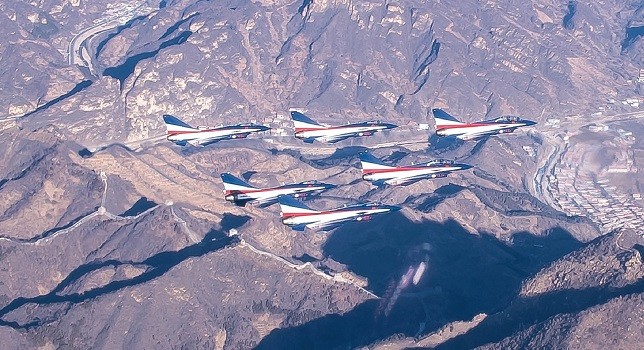
According to the standards of the United States or NATO, both the F-16 and the J -10 are considered as third-generation aircraft (unless otherwise specified, the following is the expression of jet fighter substitution according to NATO standards). This year’s "Pakistan Day", also known as the Pakistan National Day military parade, is not the first time that F-16 and J -10 appeared on the same stage to participate in the military parade. As early as March 23rd, 2019, the China People’s Liberation Army Bayi Air Show Team was invited to participate in the military parade. At that time, the superb performance of the China Air Force J -10 aircraft made the Pakistani side very envious. Although Pakistan had a famous American F-16 fighter at that time, at that time, Pakistan was suffering from this fighter.
At that time, JF-17 (FC-1 in Chinese, nicknamed "Xiaolong"), which China and Pakistan cooperated with, performed well. According to American standards, Xiaolong is at best a second-generation semi-fighter. For Pakistan, which wants to continue to supplement new fighters, how can we get a fighter that surpasses Xiaolong with reasonable price and excellent performance, and there are not many fighters that may be blackmailed? Pakistan turned its attention to China’s J -10 …
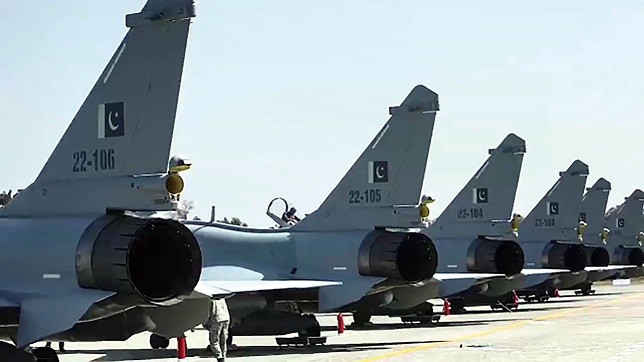
On March 11th, 2022, the Pakistan Air Force held the first pick-up ceremony of the J -10CE fighters. Pakistan thanked China for delivering the J -10CE fighter to Pakistan in a short period of time, and praised the excellent performance of the J -10CE fighter, which is another important symbol of all-weather friendship between China and Pakistan and will greatly boost the Pakistan Air Force’s leap-forward development.
For China, the export of J -10CE fighters to Pakistan is of indicative significance. This is the first time that China has exported third-generation aircraft equivalent to NATO standards. After Pakistan received the J -10CE, CCTV commented, "This indicates that China’s new generation of aviation main battle equipment has been officially installed in the Pakistan Air Force".

A symbol of China-Pakistan friendship
Pakistan attaches great importance to docking the first batch of J -10 fighters. On March 11th, not only then Prime Minister imran khan and Air Force Chief of Staff Babeur attended the pick-up ceremony, but also many senior officials from his cabinet and military, and all of them took a big photo with the six J -10CE delivered by China in the first batch.
What does the delivery of the J -10CE fighter mean to the relationship between China and Pakistan? Senior Colonel Wu Qian, Director of the Information Bureau of the Ministry of National Defense and spokesperson of the Ministry of National Defense, not only specifically mentioned that "China and Pakistan are all-weather strategic partners", but also used "true friends who share weal and woe" and "good brothers who share weal and woe" to interpret China-Pakistan relations. In China, there are many people who call Pakistan "Batie".
If it weren’t for the "iron" relationship between China and Pakistan, China’s first third-generation aircraft export, or Pakistan’s first introduction of third-generation aircraft from China, might not be so smooth. In fact, internationally, Pakistan is not the only country rumored to want to buy J -10 fighters. There are countries in South America and the Middle East that may buy J -10 fighters, or include J -10 fighters as candidates for purchase. But no country is an "all-weather strategic partner" with China like Pakistan. After signing the Treaty of Good-Neighborliness, Friendship and Cooperation between People’s Republic of China (PRC) and the Islamic Republic of Pakistan in 2005, China and Pakistan issued a joint statement in 2018, the main content of which is to strengthen the all-weather strategic partnership between China and Pakistan and build a closer community of destiny between China and Pakistan in the new era.
Compared with the relationship between China and Pakistan, for example, China and Russia are "comprehensive strategic cooperative partnership", which is indeed a relatively close diplomatic relationship, and this expression of "strategic cooperation" is only related to Russia among China’s diplomatic countries. However, from the beginning to the present, the fighter exchanges between China and Russia have all been transported by Soviet or Russian equipment to China, and there is almost no example of China’s "feedback". Looking back at history, the establishment of the China People’s Air Force, the equipment of the Air Force, from maintenance to production to design and manufacture, were originally related to the Soviet Union. For example, at the beginning of the founding of the People’s Air Force, China People’s Volunteer Air Force got the first batch of jet fighter equipment MIG -15, which came from the "big brother" of the Soviet Union. To the deterioration of Sino-Soviet relations, China once had no channel to introduce advanced fighters. At the beginning of the reform and opening-up, China sought to cooperate with the United States and other NATO countries to upgrade its J -7 fighter. This classic fighter, born out of the Soviet MIG -21, was planned to cooperate with American companies for modernization in the 1980s. But it was not finished in the end. On the contrary, Pakistan, which introduced the F-16 from the United States in the late 1980s, also actively cooperated with China. Finally, based on the J -7, it started from the "Super-7" plan in 1988 until China and Pakistan jointly developed the "Xiaolong" fighter.
"Xiaolong" has become a model of China-Pakistan cooperation, and even in the later stage of its research and development, it attracted MIG from Russia. MIG Company produced the technical data of MIG -33 aircraft. Although MIG -33, a light fighter based on MIG -29, has not been finally formed, Xiaolong has absorbed some characteristics of MIG -33, especially adopted kerimov RD-93 turbofan engine. The avionics, radar and other systems of Xiaolong adopt the way of bidding competition, including some companies from France, Britain and Italy. The "Xiaolong" who eventually served in the Pakistan Air Force has experienced many practical tests. In June 2017, Xinhua News Agency reported that "Jilong" was tested in actual combat for the first time-"A JF-17 fighter jet of Pakistan Air Force shot down a drone that may be conducting reconnaissance mission in Balochistan province. This’ Jilong’ fighter launched a thunderbolt -5E(PL-5E) missile to shoot down the target. " According to a report in Pakistan’s Dawn newspaper at that time, the PL-5E missile is an improved model of the PL-5 series missile, which is the main fighting missile of JF-17 fighter because of its light weight. It is also the main self-defense air-to-air missile of the J -7 Flying Leopard of the People’s Liberation Army, and its performance is similar to that of the AIM-9M Sidewinder missile of the United States.
From the cooperation between China and Pakistan based on the J -7 fighter, we can see that behind the military-technical cooperation between China and Pakistan, there is a background of technical exchanges between China and Russia, as well as between Pakistan and the United States. There is also the background of technical exchange between China and the West in 1980s. These three paths of technology exchange background make Xiaolong have a lot of mature and advanced technology support under the condition that the main "bloodline" remains unchanged. The ability to integrate European, American, Russian and China technologies is also exercised by AVIC, the main designer and manufacturer of Xiaolong, and its Chengdu Aircraft Industry Group. On March 23rd, 2017, which was the "Pakistan Day" of that year, Yang Wei, the chief designer of the "Jilong" aircraft jointly developed by China and Pakistan, accepted the "Star of Excellence" awarded by then Pakistani President Mamnuth Hussein at the Presidential Palace in Islamabad. Yang Wei, who was appointed as the chief engineer of Xiaolong in 2001, later became the chief designer of the domestic fourth-generation fighter J -20. From the perspective of talents, Xiaolong, a Sino-Pakistan cooperation project, also plays an outstanding role.
After the basic model of "Xiaolong" jointly developed by China and Pakistan was finalized, Pakistan’s improved models were gradually derived-JF-17 "Thunderbolt", two-seat model and oil-receiving model. It is not difficult to see that Pakistan regards Xiaolong not only as a supplement to the F-16, but as its own half-son, hoping to build its own main fighter. At the Paris Air Show in 2015, Pakistani Air Force Brigadier Khalid Mahmoud, who was responsible for the export of JF-17 Thunderbolt, said that this fighter had the first potential buyer in Asia. It was later confirmed that this "potential buyer" was Myanmar. Outside Asia, there are many people who covet the "dragon", but so far, due to the strong opposition of some NATO countries, those who favor it can only look at the "dragon"
Of course, compared with Pakistan, which mainly deals with the Indian side, China in the 21st century can’t just rely on the various "magic change" of the J -7 to ensure its airspace security and safeguard its national sovereignty. As early as the early 1990s, after the normalization of Sino-Soviet relations, China once again hoped to introduce its fourth-generation fighter aircraft from the Soviet Union, that is, the third-generation aircraft of NATO standards. From the first inspection of MIG -29 in the spirit of "MIG feelings", to the real realization that the performance of Su -27 was better and more feared by NATO as far as the Soviet Union was concerned, China finally introduced Su -27. After that, China independently developed the J -10 fighter.
At that time, as early as 1982, when Song Wencong, the chief designer of the J -7C, attended the evaluation and demonstration meeting of the new fighter development scheme in Beijing, he proposed that China should develop a new aircraft with air combat capability and canard aerodynamic layout close to the capabilities of the third generation NATO aircraft. In 1986, the J -10 project was established, with Song Wencong as the chief designer. In 1994, the prototype of the J -10 began to be manufactured. On March 23rd, 1998, Lei Qiang, a test pilot of an air force test flight brigade in Chengdu, got into the J -10 cockpit. Looking back now, this legendary test pilot has flown Russian-made Su -27, Su -30, French Mirage 2000, American-made F-16, and domestic J -10, Xiaolong and K-8 trainers. At that time, his first flight to the J -10 was risky. After all, this is China’s first three-generation fighter, and it is also the first fighter in the history of China’s fighter development to completely get rid of the Soviet Union or Russian standard.
日后,雷强接受媒体采访时曾不无轻松又不无自豪地表示,歼-10比F-15、F-16性能都好。
对21世纪初的中国来说,歼-10是一款亟需的国土防空型先进装备。自2004年中国空军换装歼-10以后,其迅速替代歼-6、歼-7和中国于20世纪60年代迈入自主研发高空高速战机时代设计制造的歼-8。2005年,带有空中加油探头的歼-10在媒体亮相。2008年11月5日,在当时的第七届中国(珠海)航展上,歼-10惊艳出场,受到国际瞩目。其时,歼-10已经有了双座型号,航电系统也基本由国产研发。2019年10月1日,1架空警-2000预警机和8架歼-10飞机组成领队机梯队,飞临天安门广场上空接受检阅。歼-10飞机拉出七道绚丽的彩烟,庆祝新中国成立70周年。
From the basic model of the J -10, to the J -10A, J -10S and J -10B, and then to the J -10C which made its first flight in December 2013, the J -10 is constantly "evolving". In April 2018, the J -10C began to take on combat duty. At present, there are four generations of J -20 aircraft in China’s naval and air forces, and before that, it has been equipped with J -11 with two engines, J -16 and J -16 electronic warfare aircraft, which are relatively heavy compared with single-engine J -10, but J -10 itself is still an important equipment of the Air Force. From the delivery of the Xiaolong, which is not equipped by the Pakistani Air Force and the Navy itself, to the delivery of the third-generation fighter J -10, the main battle of the Pakistani Air Force, to Pakistan, it can be seen that the friendship between China and China continues to deepen …
What is the export prospect of the third generation aircraft?
China’s fighter exports did not start with the J -10. Since China had its own aviation industry in 1950s, it began to export aviation equipment. Statistics show that China has exported more than 1,300 fighter planes in the 70 years before 2021. At that time, when some countries could not get Soviet-made fighter planes quickly, they turned their attention to China, such as Viet Nam and Pakistan, which had introduced China’s J -6 and J -7 aircraft and put them into actual combat. Pakistan even put the American-made "Sidewinder" missile on the J -6 plane, and put it into the war against India, and achieved good results.
In 1979, China, which has been reforming and opening up, changed its thinking of military trade and established China Aviation Technology Import and Export Corporation. Four months after the company was founded, China exported the J -6 fighter to Egypt as pilot training equipment. By the 1980s, China had exported J -7 fighters to Iran and some Asian and African countries. There are about three reasons why the J -7 fighters sold well in those years. First, at that time, local wars in the world, such as the Iran-Iraq war, both sides suffered a lot of war losses, and it was urgent to supplement fighters that could operate quickly. The J -7 was born out of MIG -21, which was similar to the models equipped by some countries themselves, and the pilots could get started quickly; Secondly, after the 1980s, the Soviet MIG -21 and American F-5E fighters stopped production one after another, and no other country in the world was producing similar second-generation supersonic aircraft, so the J -7 became almost the only option for countries that needed such fighters. Thirdly, the J -7 made in China was cheap enough.
However, the golden window period for the export of China’s second-generation machines is particularly short. By the late 1980s, the United States began to sell the third-generation aircraft-the F-16. At that time, China began to advocate the J -8, which is known as the "handsome man in the air". However, there is a generation gap between the J -8 and the F-16, and no one cares about it for many years.
Looking back at this seemingly failed history, apart from the cost performance and other factors, unlike the J -7, which was almost completely born out of the MIG -21, the J -8 is a fighter independently developed by China on the basis of the MIG -21. Although it has not completely got rid of the characteristics of the Soviet fighter, it already has many China elements. For China, this is a phased product accumulated and upgraded by the aviation industry, which is worthy of recognition. However, for foreign troops, they don’t inherit the past, and they don’t know whether they are expected to open the future. Naturally, there is a lack of buyers.
"Xiaolong" is different. To a large extent, "Xiaolong" is a fighter plane based on the J -7 platform, jointly developed with Pakistan and tailored for the Pakistan Air Force. The Myanmar side saw that Pakistan’s use of cheap and good quality "Xiaolong" had a good effect and could not help but buy it. As far as Pakistan is concerned, it is a good thing to be able to participate in the independent research and development of a relatively advanced fighter. Although it introduced the American-made F-16, the United States threatened not to allow Pakistan to use the F-16 at some important moments, such as when it came to Pakistan’s diplomatic and military decision-making. Pakistan can only be bitter about this. Therefore, being able to buy the J -10CE from China is equivalent to getting rid of the dependence on American fighters gradually in the future.
Looking back at the military and trade cooperation between China and Pakistan, before the "Xiaolong", the military aircraft exported from China to Pakistan basically had the letter "P" in the model suffix, which is the English initials of Pakistan. Such as J -7P and J -7P. Now, also imported from China, the J -10 fighters received by the Pakistani army are not "J -10P" but J -10CE. Among them, "J -10C" shows that China took the last finalized product of J -10 as the basic model for export this time, instead of taking out early models such as J -10A and J -10B or even taking out second-hand fighters for export as in the United States. On the one hand, it can be seen that China trusts and supports Pakistani friends; On the other hand, it can be seen that China has confidence in its own updated military equipment such as J -16 and J -20. And the "e" of 歼 -10CE means "export type". It is not difficult to see more other meanings-for example, besides Pakistan, this J -10C will probably be sold to more countries.
As early as 2015, it was reported that Argentina wanted to import fighter planes from China. At that time, Argentina’s eyes turned to "Xiaolong" and J -10. Xu Yongling, a meritorious test pilot of the J -10 and an air force theorist, once analyzed that "the advantage of Xiaolong is its high cost performance, with a single machine costing more than 30 million dollars. However, after all, it originated from the J -7. Based on the future, Argentina is targeting the British army that deployed six Typhoon fighters in the Malvinas Islands. Even if Argentina purchases 14 Xiaolong fighters, it will not be enough. " Xu Yongling said, "What’s more, the British army may fly in typhoons and even E-3 early warning aircraft along the route of" mainland-Gibraltar Strait-Ascension Island-Falklands "at any time. From this point of view, at least enough 歼 -10B must be purchased to counter the’ typhoon’. "
Now, seven years later, China’s export-oriented J -10 has clearly been J -10CE. For Argentina, or many have a choice.
Who is maintaining peace and who is fanning the flames?
However, it must also be noted that after seven years, Argentina still hasn’t placed an order for China fighters, and the reason behind it is not only its vacillation in choosing Xiaolong or J -10. The main reason is that the United States has repeatedly obstructed it behind its back. The United States has repeatedly recommended second-hand fighters to Argentina. For example, in 2021, when it was discovered that Argentina was still negotiating military aircraft projects with China, the United States took out a number of second-hand F/A-18C/D fighters. Seeing that Argentina was indifferent, the United States suggested to Argentina that Argentina should buy a batch of second-hand F-16 fighters of the Danish Air Force.
As early as 1975, the United States signed a cooperation agreement with Belgium, Denmark, the Netherlands and Norway to jointly produce 348 F-16 fighters, all of which will be equipped to the air forces of these four European countries. Denmark took the lead in ordering 77 F-16A/B fighters. By the mid-1990s, Denmark bought seven more fighters from the United States to make up for the losses caused by long-term use. In 1991, these four European member States decided to develop a fully upgraded fighter, and prepared to raise the F-16 to the standard of Block52 at that time. In terms of structure, they also strengthened some key parts through the aircraft structural integrity plan, so that they could reach the expected life of flying for 8,000 hours.
In November 2021, the Danish Ministry of Defence and the Ministry of Purchasing announced at the same time that they would start selling second-hand F-16A/B MLU fighters in stock from the following year, and about 8 fighters could be provided in 2022. In doing so, Denmark has reduced its defense expenditure and disposed of some junk in this way. These F-16s sound like third-generation aircraft, but they are actually a group of "grandfather" aircraft with a remaining life of 5 to 10 years. If it is not properly maintained, a frame will quickly become a "flying coffin". Argentina has so far been afraid to place an order.
In fact, whether the United States is engaged in normal military trade or is using all kinds of American-made equipment to fan the flames, we only need to look at the situation on the battlefield in Ukraine to understand. After the war between Russia and Ukraine, the United States only provided Ukraine with shoulder-mounted individual anti-tank missiles such as Stinger. As for the fighters and tanks that Ukraine hopes to get, the United States itself will not give them. Of course, what Ukraine hopes to get is nothing more than its own Russian-made equipment such as MIG -29. The United States first instigated Poland, the Czech Republic and other Warsaw Pact countries to give their MiG -29 to Ukraine. What Poland has done is to propose to transfer its MiG -29 to the US military base in Ramsteijn, Germany, and let the United States hand it over to Ukraine, and then hope that the United States will provide American-made equipment such as F-16 to supplement it. What does America do? Play dumb and quit!
Does the United States really regard Ukraine and Poland as friends? Or is it used to fight against Russian chess pieces? From how to treat these MIG -29 fighters in Poland, we can see why. What about the military and trade cooperation between China and Pakistan? "China is willing to work with Pakistan to accelerate the construction of a closer community of destiny between China and Pakistan in the new era. The relationship between the two armies is the mainstay of China-Pakistan friendship, which has played an important role in the development of bilateral relations for a long time. The two sides have achieved fruitful cooperation in the fields of high-level exchange visits, joint performances and training, anti-epidemic cooperation, equipment technology and so on, constantly enriching the connotation of strategic cooperation between the two countries. In the next step, under the leadership of the leaders of the two countries, the Chinese and Pakistani armed forces will push pragmatic cooperation in various fields to a new level, inject new impetus into the all-weather strategic partnership between the two countries, and contribute new strength to maintaining regional peace and stability. " I believe what Wu Qian said at the regular press conference of the Ministry of National Defense, true peace-loving people all over the world can listen clearly and understand! (lead author Jiang Haofeng)
Link: jet fighter generation
Since the rise of jet fighters after World War II, the United States and the Soviet Union have become the top two fighters in design and manufacture. American-made F-86 and Soviet-made MIG -15 each took the lead. In the generation of military aircraft, these two fighters are regarded as the first generation of jet fighters. Since then: when the jet fighter equipped with missiles came out, the Soviet Union recognized it as the second generation fighter; Supersonic fighters equipped with missiles are third-generation fighters. The United States-led NATO has roughly classified subsonic and supersonic fighters that began to be equipped with missiles into the second generation. After that, NATO’s third-generation aircraft, such as F-15, F-16 and F-18, were equivalent to Russian standard fourth-generation aircraft, such as Su -27 and MiG -29. While the third-generation aircraft of the United States and the Soviet Union are competing in the world’s airspace, China’s fighter manufacturing still stays at the level of the second-generation aircraft. Until the first flight of the J -10 fighter in 1998.