Ridiculous! Repeatedly challenging the national bottom line with "Jingri" remarks and saying "no malice"
At 10 am on April 8, 2019, a slogan of "Jingri" insulting China suddenly appeared on the electronic billboard of the emergency building of Gaoyang County Hospital in Hebei Province.
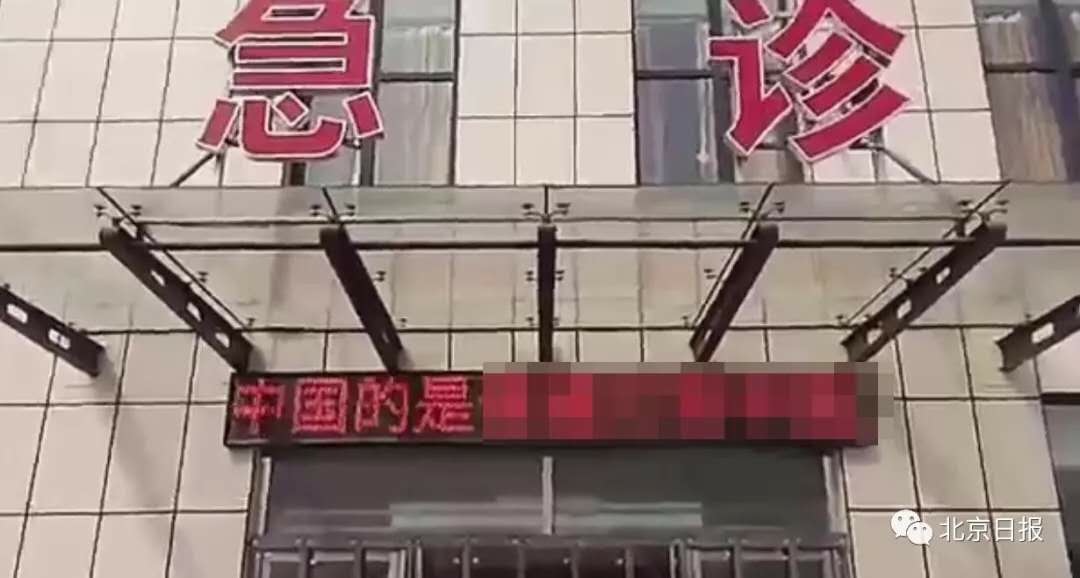
"Jingri" insulting remarks appeared on the electronic bulletin board of Gaoyang County Hospital (Source: Beijing Daily official WeChat)
Witnessing netizens immediately took the video and uploaded it to the network, which immediately triggered strong indignation and unanimous condemnation from netizens. "‘ Jingri ’ It’s too arrogant ","If you find the culprit, you must be severely punished "… …
At 19: 00 pm on April 8, the official Weibo of Gaoyang County Public Security Bureau announced that the suspect Li Moumou (male, 31 years old, from Gaoyang County) had been arrested at 3: 00 pm on April 8, and the case was under further investigation.
At 22: 40 p.m. on April 9th, Weibo, the official of Gaoyang County Public Security Bureau, issued a warning notice saying that the suspect Li had worked for a communication technology company before the incident. On the morning of April 8th, Li went to Gaoyang County Hospital to accompany the patient, during which he used his mobile phone to connect the LED screen of the emergency department of the hospital and made insulting remarks. On April 9, Gaoyang County Public Security Bureau criminally detained Li on suspicion of seeking trouble.
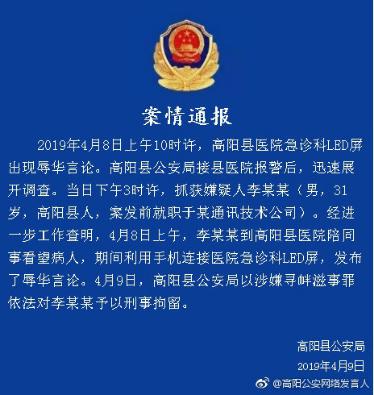
Gaoyang County Public Security Bureau issued a briefing on the case (Source: Gaoyang County Public Security Bureau official Weibo)
The insulting remarks of "Jingri" once again hurt the sensitive nerves of the public.
"Jingri" is the abbreviation of "Spiritual Japanese". As a typical negative network reference, it refers to the non-Japanese people who extremely worship Japanese militarism and hate their own nation, and mentally regard themselves as militaristic Japanese. The specific manifestations are infatuation with Japanese uniforms in World War II, taking photos at Japanese aggression sites, and vilifying anti-Japanese heroes.
Some experts pointed out that the emergence of the word "Jingri" was closely related to Japan’s special policy in the process of foreign expansion and colonization during the imperialist period, that is, artificially transforming the people in the controlled areas in terms of cultural identity, so as to isolate the original cultural attributes and make them spiritually extend into Japanese people.
"Jingri" elements are often people who feel inferior to their national culture. In the process of their contact with Japanese culture, they have a sense of frustration of national spirit, which gradually develops into extreme worship of Japan, even to the point of hating their own nation and being ashamed of being Chinese.
In recent years, similar "Jingri" insulting remarks have appeared from time to time, and the so-called "Jingri" elements have repeatedly challenged the bottom line of national dignity.
On February 20, 2018, some netizens exposed photos of two men posing in front of Nanjing Zijinshan Bunker in imitation of Japanese military uniforms of World War II in Weibo. When the photo came out, public opinion was at a loss. Two days later, Nanjing police arrested Tang and Zong, the offenders involved in the case, and imposed administrative detention on them for 15 days respectively.
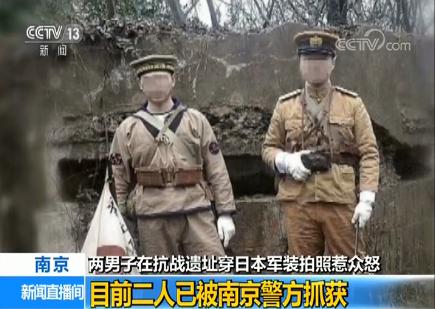
Two men took photos in Japanese military uniforms at the Anti-Japanese War site, causing public outrage (video screenshot)
On March 8, 2018, in the WeChat group of "Nanjing Part-time Full-time Group 2", a netizen named "Santa Claus" on WeChat spoke in the group: "Nanjing is a pit, and the Japanese should be slaughtered again." Subsequently, the speech was forwarded and spread, and caused bad influence in the network. After investigation by the police, Wang, a 27-year-old Shandong man, made the above extremely vicious remarks to vent his dissatisfaction because he went to Nanjing to find a job and suspected that his salary was low. On March 10th, Wang was criminally detained by Nanjing police.
On August 6th, 2018, Weibo user "Shiba Tatsuya Taijun" published extreme remarks that violated national laws and desecrated national feelings, such as "Which law forbids talking about Taiwan Province" and "Prime Minister Abe is my own father" in the Weibo comment area of "Mianyang Internet Police Patrol Law Enforcement". On the afternoon of August 14th, "Mianyang Internet Police Patrol Law Enforcement" shouted "Shiba Tatsuya Taijun": Go to the public security organ and surrender as soon as possible! Seeing this scene, the user deleted Weibo, and replied: "Don’t arrest me, police comrades" and "I’m just complaining, not malicious".
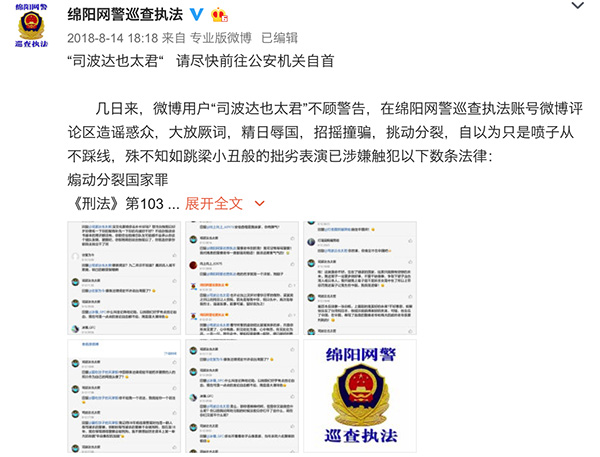
"Mianyang network police patrol law enforcement" shouted "Shiba Tatsuya Taijun": go to the public security organ as soon as possible to surrender (Source: Mianyang City Public Security Bureau Network Security Detachment official Weibo)
After investigation, Yang Moumou, an 18-year-old unemployed person, made the remarks. In April 2018, he was reprimanded by the public security organs for posting bad comments on the Internet. According to the relevant national laws and regulations, Yang’s behavior was suspected of constituting the crime of seeking trouble and was criminally detained by the public security organs according to law.
What is even more outrageous is that someone once sold "Jingri" speech on the media platform, and gained eyeballs, created panic and even made profits through a large number of inflammatory articles. According to media reports, the advertising price of this account was even nearly 10,000 yuan.
You can make fun of national scars to vent your dissatisfaction? Trying to gain eyeballs and seek benefits by insulting articles on "Jingri"? Think you can escape legal sanctions by deleting blogs and apologizing? No! Save! Yes! Yes!
The behavior of "Jing Ri" breaks through the bottom line of normal social behavior, which is serious enough to involve national and ethnic identity. This is not an immoral behavior of improper personal speech, but a direct expression of distorted values, a blasphemy against the martyrs’ spirits and a trampling on national consensus.
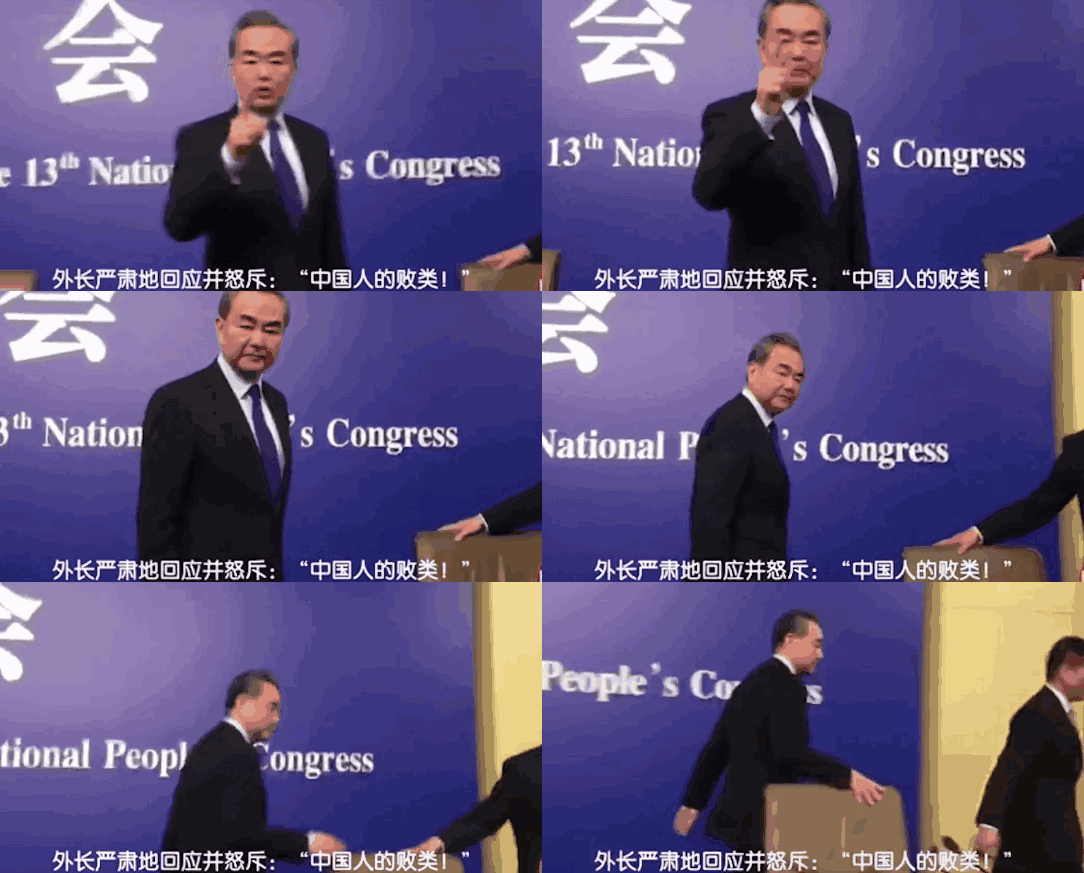
During the two sessions of the National People’s Congress in 2018, when Wang Yi, State Councilor and Foreign Minister, responded to the media’s questions about the behavior of "Jingri" at the press conference, he waved his hand seriously and angered: "The scum of Chinese!"
On December 13, 2018, the Regulations on the Protection of National Public Sacrifices in Nanjing was officially implemented, which marked the "legal red line" for the "fine day" behavior for the first time.
Chapter IV, Article 28 of the Regulations stipulates: It is forbidden for any unit or individual to distort or deny the historical facts of the Nanjing Massacre, insult or slander the victims and survivors of the Nanjing Massacre, and fabricate or disseminate statements or information containing the above contents that are detrimental to the dignity of the country and the nation and hurt people’s feelings;
Article 29 stipulates that it is forbidden to use military uniforms, flags, icons or related props with symbolic significance of Japanese militarism in national public sacrifice facilities, anti-Japanese war sites and anti-Japanese war memorial halls, take photos, record videos or publicly spread the above behaviors through the Internet.
Article 30 stipulates that it is forbidden for any unit or individual to infringe upon the legitimate rights and interests such as the names, portraits and reputations of the victims and survivors of the Nanjing Massacre.
The "Regulations" clarify that those who violate the provisions of Articles 28 and 29, insult and slander others, stir up trouble, disturb public order, publicize and beautify wars of aggression and acts of aggression, which constitute violations of public security management, shall be punished by public security organs according to law; If a crime is constituted, criminal responsibility shall be investigated according to law.
Anyone who violates the provisions of Article 30 and infringes upon the legitimate rights and interests such as the names, portraits and reputations of the victims and survivors of the Nanjing Massacre shall bear civil liability according to law.
National scars should not be an outlet to vent negative emotions, nor can youth and ignorance be used as a cover to insult national dignity. Citizens’ personal words and deeds, all words and deeds in public places and public cyberspace, can not exceed the bottom line of the law and damage national dignity, otherwise they will be severely punished by the law.