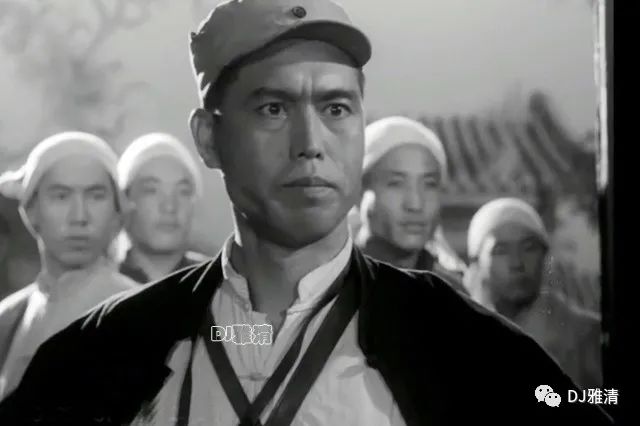
Ye Ping, witness our first military parade and the birth of the title "Chairman Mao"!

Author: Gao Bin, Front Line Magazine of Beijing Municipal Committee of the Communist Party of China.
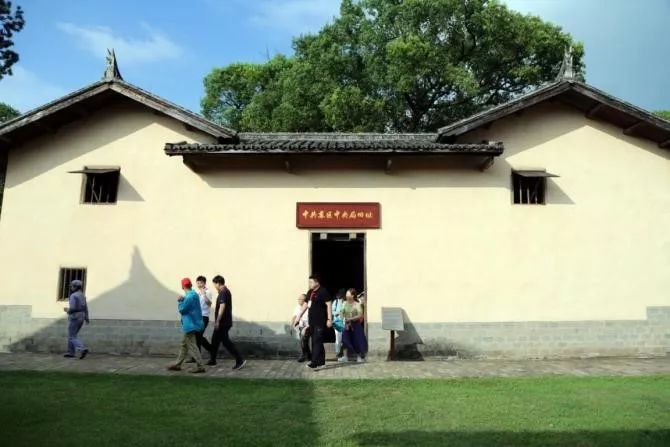
 

From November 7 to 20, 1931, the first national congress of the Soviet Union of Chinese workers, peasants and soldiers was held in Yeping Village, Ruijin. The congress announced the establishment of the provisional central government of chinese soviet republic. The picture shows the former site of the Central Bureau of the Central Soviet Area.


During the National Day holiday, the circle of friends was repeatedly screened by videos and photos of the National Day military parade in the 70th anniversary of the founding of New China.

The neat lineup, loud slogans, roaring locomotives and roaring planes of previous National Day military parades have made countless Chinese people proud and excited.

Before the founding of New China, there were several military parades in the history of our army, such as the "August 1st" military parade, the Xiyuan military parade and the Yan ‘an airport military parade. When and where was the earliest military parade? When did the title "Chairman Mao" begin?

In the former site group of Yeping Revolution in Ruijin, Jiangxi, the reporter found the answer.

Yeping Red Army Review Platform —— Witness the first military parade in the history of our army

Yeping Revolutionary Site Group is located in Yeping Village, Yeping Township, Ruijin City, Jiangxi Province. It is the birthplace of chinese soviet republic and one of the best-preserved revolutionary site groups in China. The Yeping Revolutionary Site Group has reserved a site-the Red Army Review Desk.
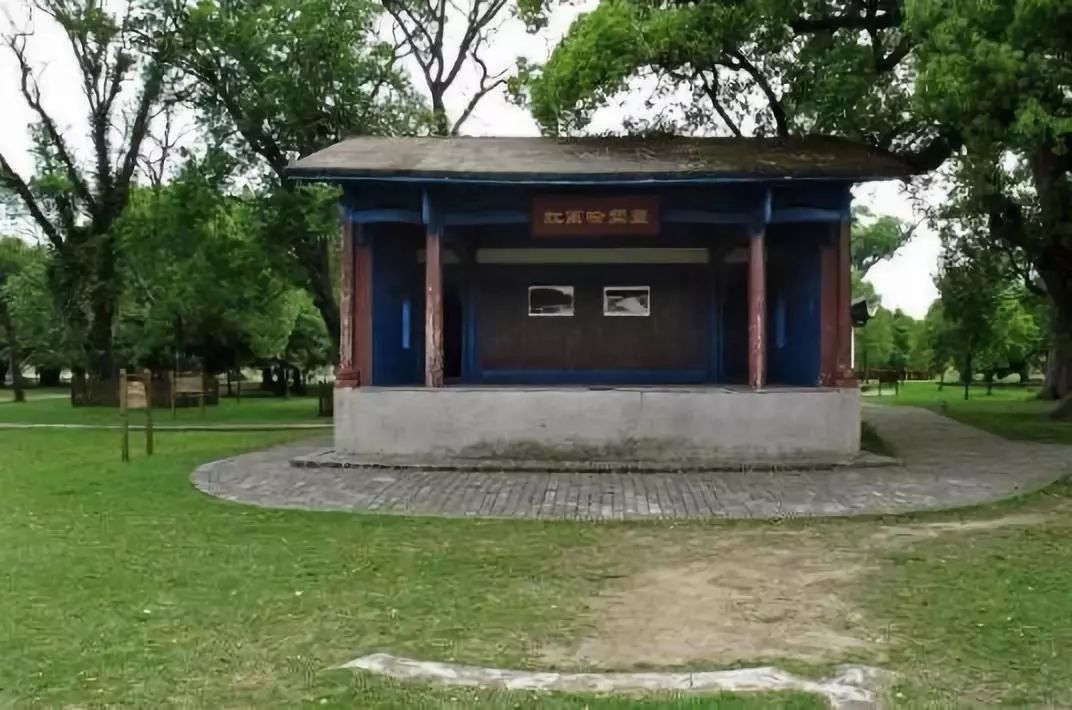
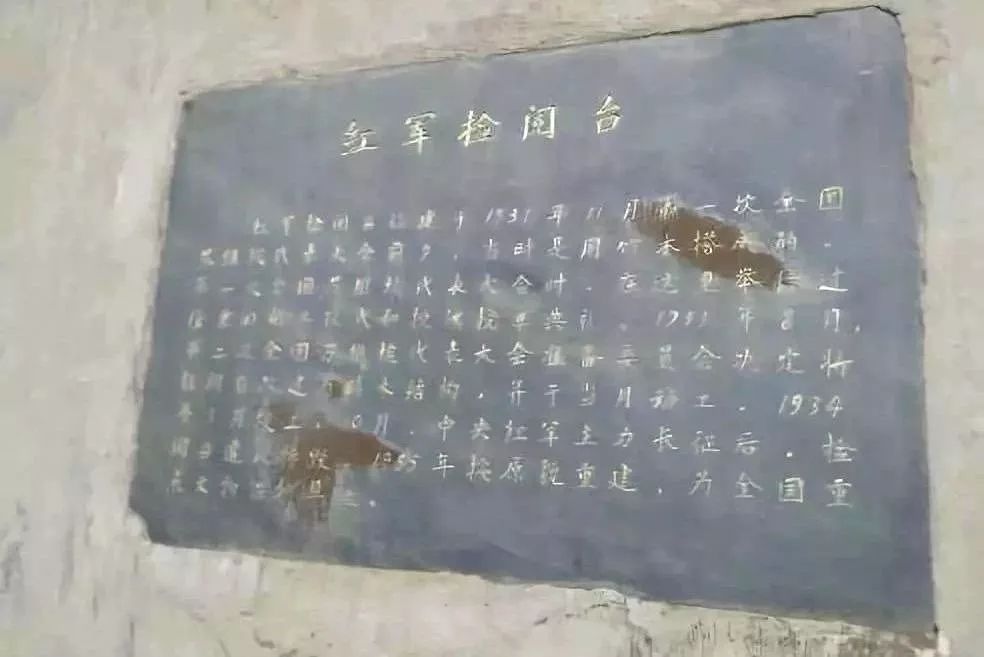
In preparation for the first National Congress of the Chinese Soviet Union to review the Red Army, the Red Army Review Platform was a simple and convenient platform made of bamboo and wood. 

In front of the reviewing stand is the spacious Yeping Red Army Square. The ground is covered with lawns, and a line of big characters is highlighted on the ground-along the blood of the Red Army. There is also a towering Red Army Martyrs Memorial Tower and a solemn Red Army Martyrs Memorial Pavilion next to the square.
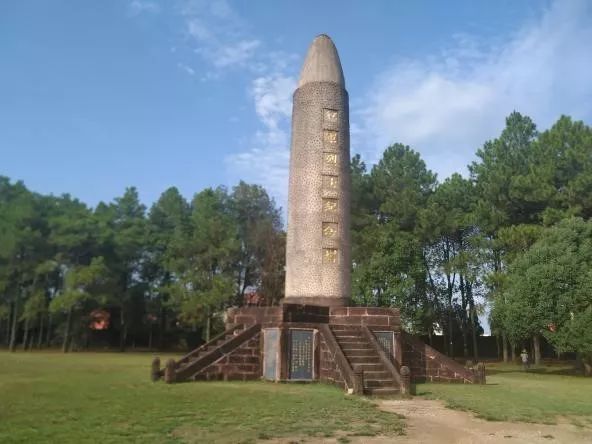
The 13-meter-high Red Army Martyrs Memorial Tower designed by Qian Zhuangfei has a pentagonal tower base and a shell-shaped tower body.


On November 7, 1931, it was the celebration day of the October Revolution in the Soviet Union. On this day, the first congress of workers, peasants and soldiers in chinese soviet republic was held at the Xie Ancestral Hall in Yeping Village, Ruijin, Soviet Union. A grand military parade was held before the opening of the conference, which was the first large-scale official military parade recorded in the history of our army.

In order to prepare for the parade, Ceng Shan, then chairman of Jiangxi Soviet, and Deng Xiaoping, then secretary of Ruijin County Party Committee, led Ruijin people to open a square that could accommodate more than 10,000 people in a forest in the northeast of Yeping Village, and built a Red Army reviewing platform with bamboo and stone. 

In the middle of the reviewing platform, there is a huge red cloth hanging across the reviewing platform of the Red Army of the First National Soviet Congress, with portraits of Marx and Lenin hanging behind it, and flags of the Chinese Red Army of Workers and Peasants on both sides. In order to prevent the invasion of enemy planes, this military parade was specially arranged at 7: 00 am on November 7.

The troops participating in the reading are mainly representatives of the Red Army’s various regiments and armies, the Red Army’s camp schools, and representatives of the security forces. More than 600 delegates, including the Red Army troops from various Soviet areas and the All-China Federation of Trade Unions located in the Kuomintang-ruled areas, attended the celebration together with the people from Soviet areas who came to watch the ceremony.

At 7 o’clock sharp, Mao Zedong, Zhu De, Xiang Ying, Ren Bishi, Wang Jiaxiang, Peng Dehuai, Chen Yi and Ceng Shan boarded the reviewing stand in turn, and the military parade officially began.

Mao Zedong, general political commissar of the Red Army, dressed in a Chinese tunic suit, presided over the military parade.

Teams of heroic Red Army soldiers, columns of Red Guards and Young Pioneers shouted "Long live the Red Army!" "Long live the Soviet Union!" "Long live the Communist Party of China (CPC)!" Slogan, neatly through the reviewing stand parallel attention.

Accompanied by Chief of Staff Ye Jianying, Zhu De, Executive Chairman of the General Assembly and Commander-in-Chief of the Red Army, rode to inspect the troops and personally led the troops under review to take the oath. The whole military parade lasted about an hour.
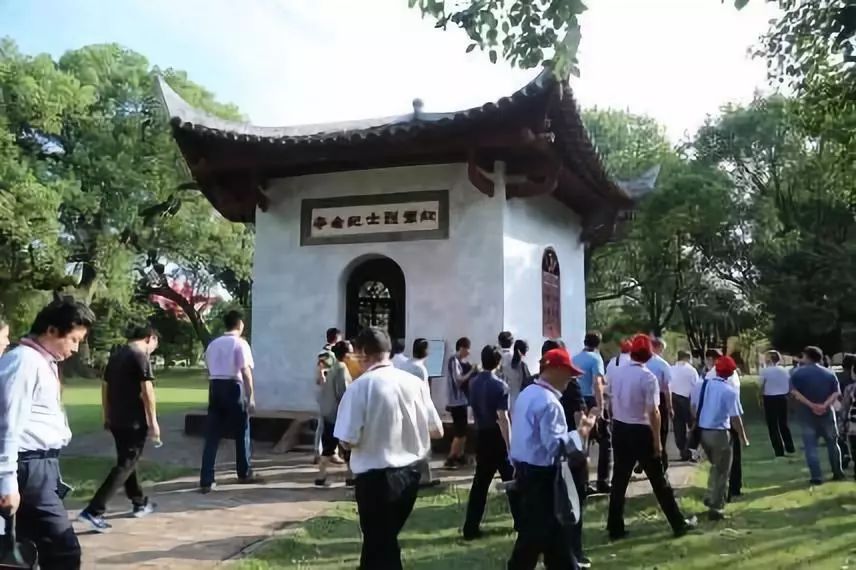
Memorial Pavilion of Red Army Martyrs in Yeping Revolutionary Site Group


Ran Ran, the Oriental Red Sun, rose, the military parade ended successfully, and people quickly evacuated according to the predetermined plan. At this time, several planes of the Kuomintang attacked, but no abnormalities were found. After dropping several bombs, they flew in the direction of Changting, Fujian, and bombed the fake venue where the Preparatory Committee for the Conference was arranged.
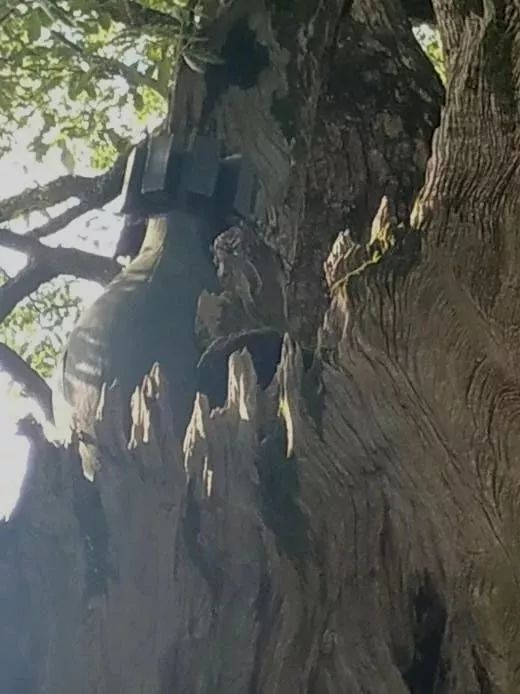
On an ancient tree next to Comrade Mao Zedong’s old residence in the former site of Yeping Revolution, there is still a bomb that the enemy dropped and failed to detonate embedded in the branch.


Mao Zedong said humorously at that time: "Chiang Kai-shek is really a friend, knowing that we set up the Soviet Union today, held a military parade, and sent a special plane to entertain us!"

Yeping Revolutionary Site Group —— Witness the birth of the title "Chairman Mao"

After the military parade, from November 7 to 20, 1931, the first national congress of the Chinese Soviet was held in Yeping, Ruijin. Attending the meeting were representatives from the Central Soviet Area, western Fujian, northeastern Jiangxi, Hunan and Jiangxi, Hunan, Hubei and Jiangxi, Qiongya and other Soviet areas, as well as representatives from the Red Army, the All-China Federation of Trade Unions and the All-China Seamen’s Trade Union, totaling 610 people. On behalf of the Soviet C.O., Mao Zedong made a Report on Political Issues to the General Assembly. The Congress adopted the Outline of the Constitution of chinese soviet republic, the Land Law of chinese soviet republic, the Labor Law of chinese soviet republic and chinese soviet republic’s Decision on Economic Policy. A Central Executive Committee composed of 63 members including Mao Zedong, Xiang Ying, Zhang Guotao, Zhou Enlai and Zhu De was elected.
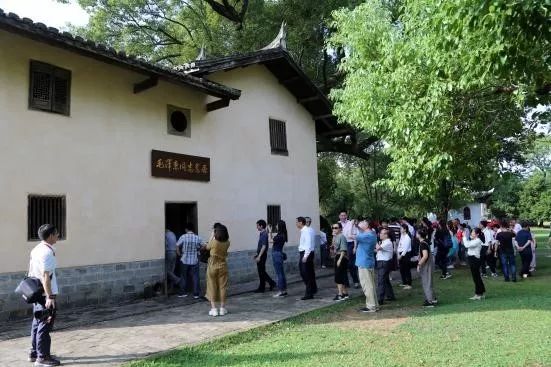
Former Residence of Comrade Mao Zedong in Yeping Revolutionary Site Group

After the conference, Ruijin was renamed as "Ruijing" and Ruijin County was designated as a county directly under the Soviet Provisional Central Government. Ruijin thus became the red capital of chinese soviet republic.

On November 27th, 1931, in the dense forest of Yeping Village, Mao Zedong presided over the first plenary meeting of the Central Executive Committee of chinese soviet republic. The meeting elected Mao Zedong as the chairman of the Central Executive Committee and the chairman of the Central People’s Committee according to the procedure stipulated in the Soviet Organic Law.
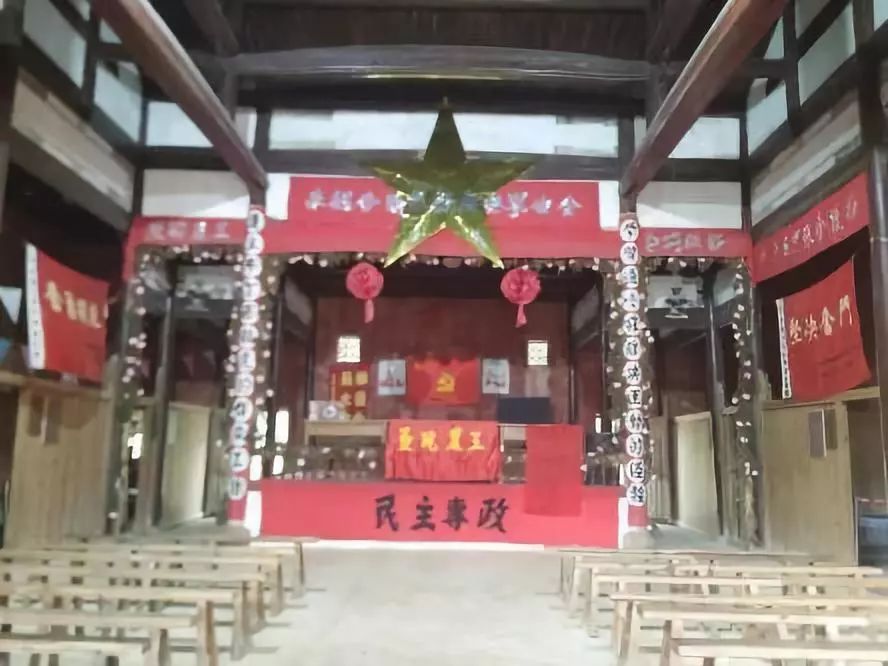
Chinese soviet republic temporary central government office former site


At that time, Ren Bishi, the host of the conference, stepped onto the rostrum and proposed on the spot: "Please ask Chairman Mao to speak!"

For a time, everyone didn’t react to who he called, and then everyone turned their attention to Mao Zedong. In the warm applause, everyone shouted "Chairman Mao!" The title of "Chairman Mao" is also called open.

The article was published on WeChat WeChat official account "Dongfanghong", please indicate the source.

The picture comes from "Grateful Endeavour, A New Chapter of the Cradle Spectrum of the Republic" —— All-media Jiangxi reporters of the National Party Journal Shen Jinxiang and Gao Bin.
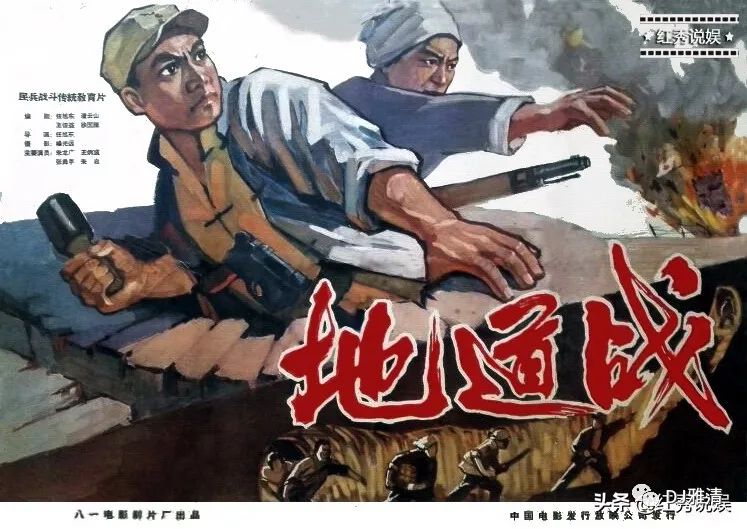
The film Tunnel Warfare Longguang Zhu Zhang Yongshou is alive, while Yamada and Commander Tang have passed away.

Original Hong Xiu Shuo Entertainment DJ Yaqing

In the 1960s, this excellent theme was selected by Bayi Factory, and it was decided to make a film "Tunnel Warfare". Later, Xudong Ren, Xu Guoteng, Wang Junyi and Pan Yunshan wrote the script and constantly polished it. In 1965, the film Tunnel Warfare was filmed and released on New Year’s Day in 1966. By the end of 2012, this film has set a record of billions of people watching it, and it can be said that it is one of the most familiar movies for Chinese people.

Fu Gengchen, who is in charge of the soundtrack in the film, has written songs for many outstanding works such as Sparkling Red Star, Advancing into the Central Plains and Sparkling Red Star. Fu Gengchen was only 29 years old when he wrote music for Tunnel Warfare.

Anyone who has seen the movie "Tunnel Warfare" should be deeply impressed by the theme song "Tunnel Warfare" and the episode "Chairman Mao’s Words". In fact, the author of the lyrics is Xudong Ren, the director of this film. Accompanied by "the sun shines everywhere, Chairman Mao’s thoughts shine golden", Gao Chuanbao read "On protracted war"; "Guerrilla warfare was launched in the Great Plains, and villages and households were connected into tunnels. The invaders dared to come and beat him to death." The enemy was defeated. The song in "Tunnel Warfare" was once described as follows: The enemy was frightened when he heard it; Hearing this, the people are full of blood and infinite strength in their hearts!

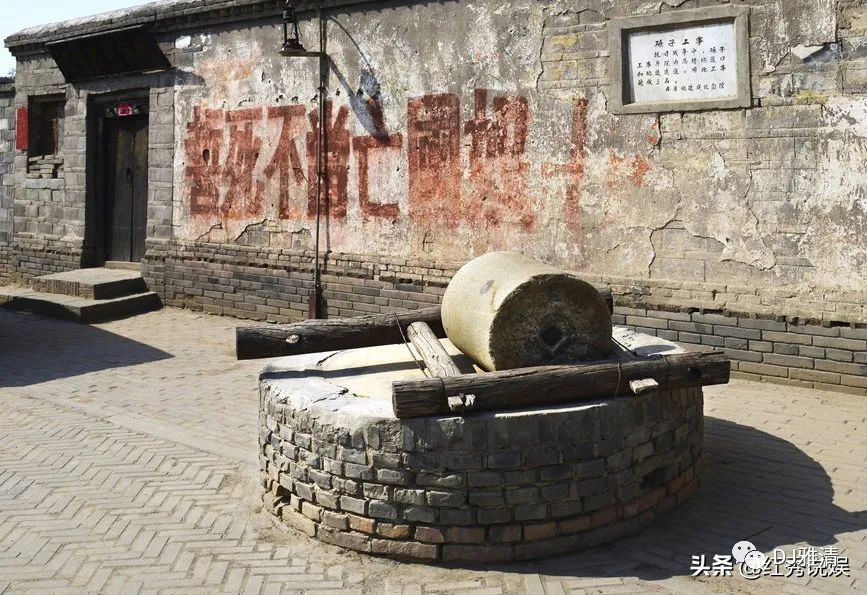
The prototype of "Gaojiazhuang" in the film is Gaoping Village, Zhengding County, Hebei Province, which is also called "Anti-Japanese Pioneer Village". But at that time, because of the flood, the local tunnel did not meet the shooting conditions. The film crew turned to Ran Zhuang, Lizhuang and Tangzhuang, which were nearby, for combined shooting, and tried to restore the scene at that time.

Ranzhuang Tunnel Warfare Site

The tunnels criss-crossing in the movie and the shadowy guerrillas must have left a deep impression on everyone. In fact, all the pictures in the tunnel in the film were set in Bayi Factory, but with excellent lens application, it looks like shooting in a real tunnel.

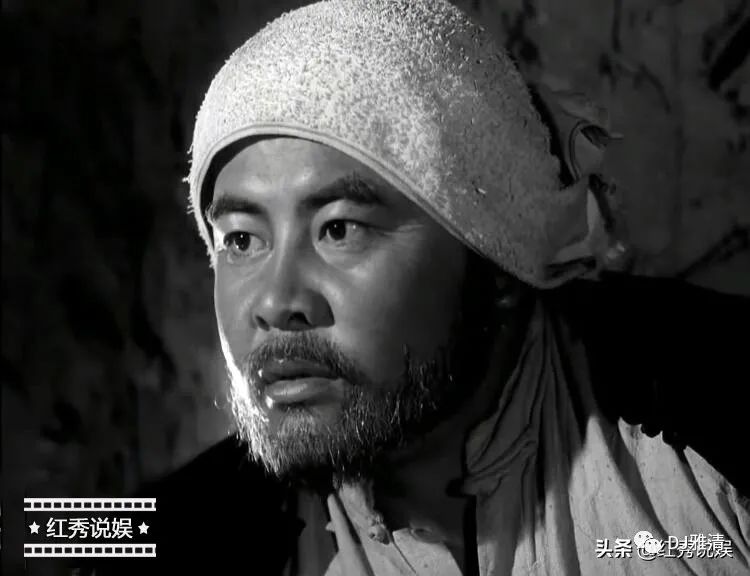
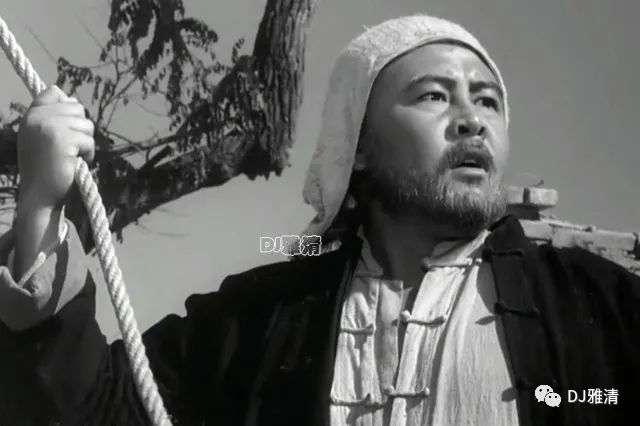
In the movie, the first appearance is Gao Laozhong, the party branch secretary played by Bingyu Wang. In order to cover the villagers’ evacuation and escape, he risked his life to sound the alarm, but unfortunately he was discovered by the Japanese army, and finally he sounded a Grenade and died with the enemy. When playing this role, Bingyu Wang was actually only in his twenties, but it was a big test to play a father and son with Longguang Zhu, who was similar in age, and to show a sense of vicissitudes of life.

Bingyu Wang, an actor from Beijing Film Factory, has played the roles of Uncle Man in Private Zhang Ga, Zhou Yunpeng in Journey to Wan Li and Liu Dabo in Hai Xia. Unfortunately, Bingyu Wang died in 1982 at the age of 47. It’s a pity that we didn’t see more of his works on the screen.

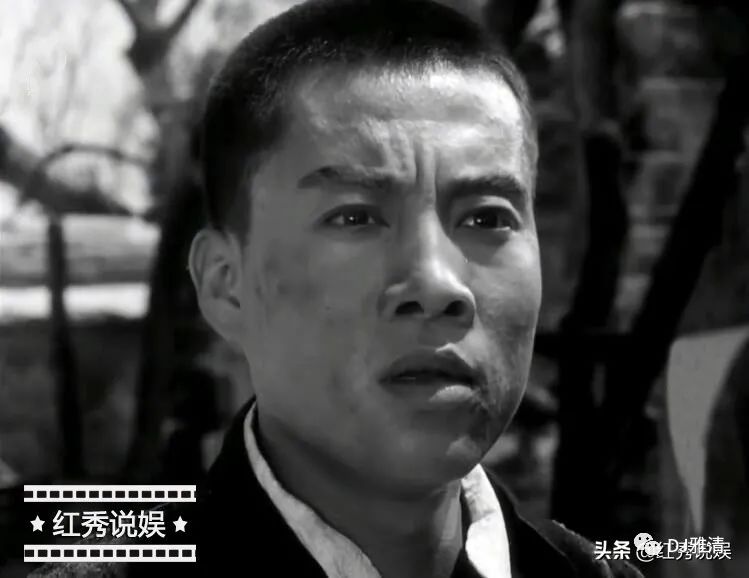
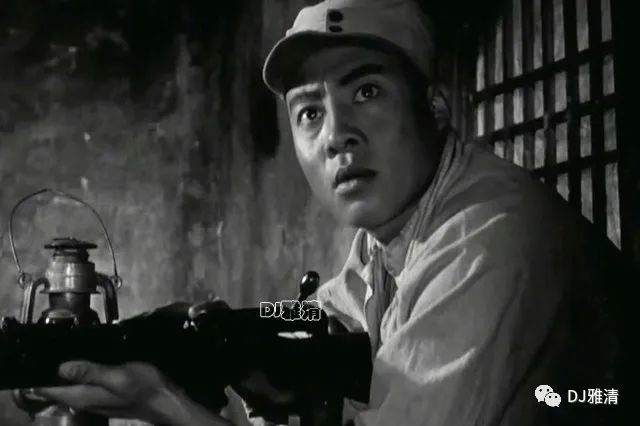
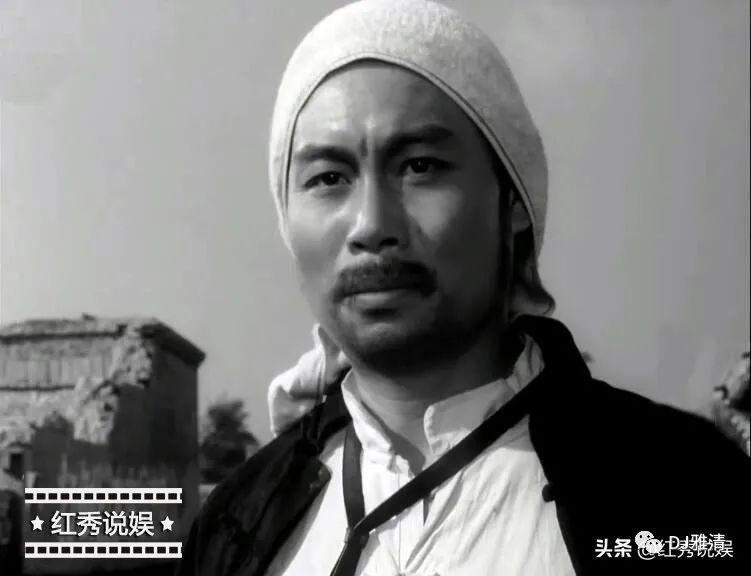
Gao Chuanbao, the son of Gao Laozhong and the captain of the militia, was played by actor Longguang Zhu. He also performed brilliantly in films such as "Jiao Yulu" and "Wooden House". Besides, he also played an amazing role, that is, the Tathagata Buddha in the 86th edition of The Journey to the West. Do you know? If it weren’t for the introduction of the audience, I wouldn’t have recognized him as Gao Chuanbao who was praised by director Xudong Ren as "handsome, mighty and good at acting". In September this year, it was Longguang Zhu’s 82nd birthday, and Hong Xiu wished him a long and healthy life, smiling often.

The prototype of Gao Laozhong and Gao Chuanbao was Liu Fool, the party branch secretary and militia captain of Gaoping Village at that time. Although his name didn’t sound severe, during the War of Resistance against Japanese Aggression period, he led a militia team of 70 or 80 people to repel thousands of Japanese attacks.

Zhao Ping, the district chief who formulated the "Sparrow" tactics, was originally played by Zhang Yongshou. He has played Shao Jianbo in Lin Hai Xue Yuan and Fang Yong in Surprise. As a famous actor and director of Bayi Film Studio, Zhang Yongshou has many works on the screen.

He is also regarded as Liu Xiaoqing and Tang Guoqiang’s Bole on the road of performing arts. At that time, when filming the movie "South China Sea Storm", he chose Tang Guoqiang; When filming the Great Wall of the South China Sea, he chose Liu Xiaoqing. Today, 87-year-old Zhang Yongshou and his wife Zhang Jiamao live in Beijing. Zhang Xihe, the eldest son, and Zhang Wang, the second son, are both film and television workers. Zhang Wang is a famous producer, who has produced films such as Sunny Days and The Great Wall. The youngest daughter, Zhang Man, is developing her career abroad.

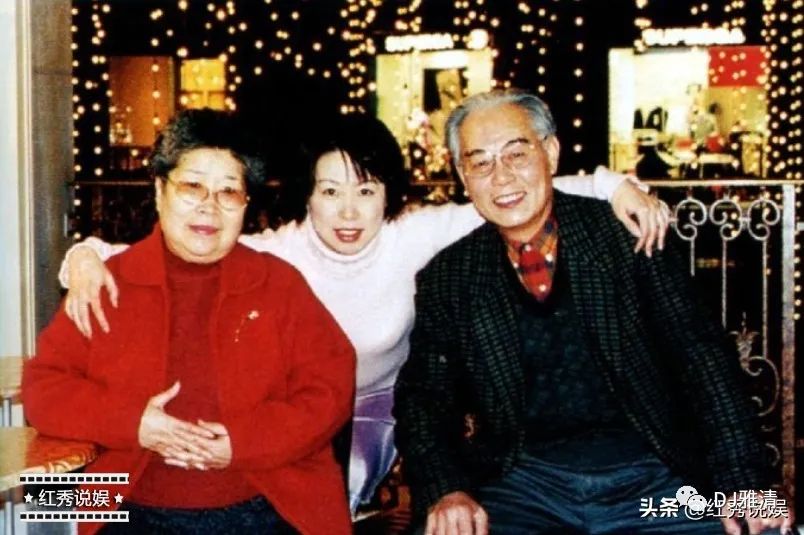
Zhang Yongshou and Zhang Man.

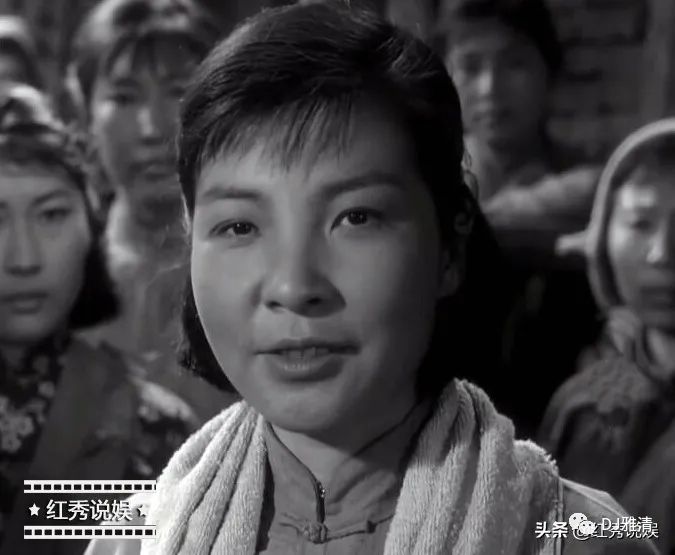
Xiujie Liu, who plays Lin Xia, director of the Women’s Rescue Association, has only appeared in a few films, but her simple and natural performance can touch many audiences, and her performance is both physical and mental. In the film, she said to Longguang Zhu, "Pass the treasure, be careful" is gentle; He was firm when he said, "We want to fight wolves, but we can’t let them bite us.". However, in the later stage of Xiujie Liu’s acting career, little information can be found, but the Lin Xia she created has been fixed in the hearts of the audience. On July 27th, 2020, Xiujie Liu died at the age of 87.

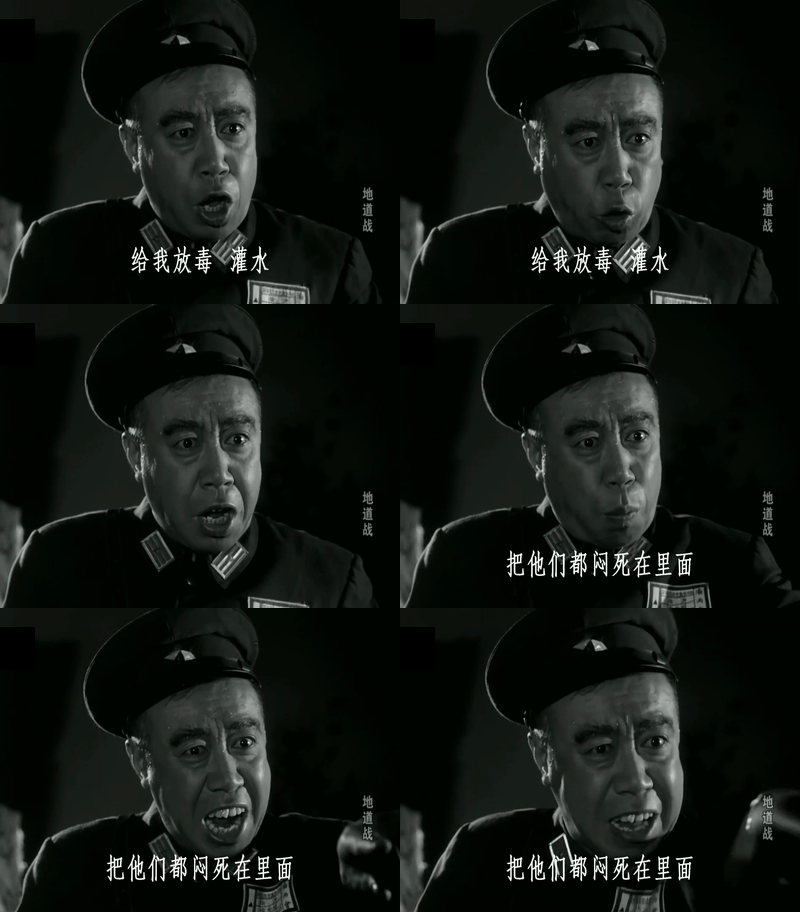
Wang Xiaozhong, an old actor with rich experience in villains on the screen, plays the Japanese army captain Yamada in Tunnel Warfare this time. When Wang Xiaozhong was young, he studied in the Telecommunications College of Fengtian Railway Institute set up by the Japanese, and many teachers in the school were retired soldiers. I think this is also the reason why he played a very thorough role in the image of Japanese soldiers. He has appeared in the image of Japanese many times on the screen, such as Nakamura, the special high-tech director in Never Gone Radio, and Tada, the intelligence consultant in Wildfire and Spring Breeze Fighting the Ancient City. But every role he plays is different, and in his opinion, even a supporting role needs careful consideration. On January 22nd, 2016, Wang Xiaozhong died in Guangzhou at the age of 88.

Tang Bing, commander of the Imperial Association Army, will be played by the famous actor Liu Jiang. Liu Jiang likes performing arts since he was a child, and he is particularly interested in movies and dramas. He has appeared in the movies "Sparkling Red Star" and "Breaking through the Wujiang River", and has also created many classic vivid images, leaving impressive lines, such as "I’m Hu Hansan back!" And "high, really high!" .

However, he was in poor health in his later years: in 1995, Liu Jiang was diagnosed with various cancers. However, he is optimistic and cheerful, but he has also appeared in several films, most of which are positive images. On May 1, 2020, Liu Jiang died in his sleep at the age of 95. This also means that the "five villains" on the screen: Ge Cunzhuang, Statement, Chen Qiang, Fang Hua and Liu Jiang have all passed away.

There are many excellent supporting actors in the film, such as Zhu Qi who plays Cui Lianchang, Han Dong who plays Dakang, and Hu Zihe who plays Niu Wa. Zhu Qi died in 2007; Han Guodong and Hu Ziru are both actors of the Cultural and Art Troupe of the Political Department of the Corps of Engineers, and Hu Ziru once served as the vice captain of the drama team.

Pay tribute to the previous artists for their dedication to China’s film industry. One of the classic lines, such as "quietly into the village, don’t shoot!" Do you remember? I wonder how much the audience still remembers the plot in Tunnel Warfare? Welcome everyone to interact with more netizens and fans through the message area. I’m Hong Xiu. Thank you again for your attention, praise and sharing.

This article is original by Hongxiu. Please don’t copy it without permission! Offenders will be prosecuted!

Original title: The movie "Tunnel Warfare" Longguang Zhu Zhang Yongshou is alive, "Yamada" and "Commander Tang" have passed away.

Read the original text