The "professional counterfeiting" suspected of extortion hit the legal muzzle.
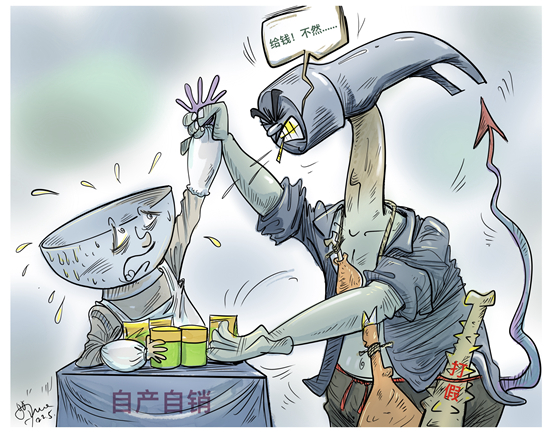
Comic: Xu Jian
It is reported that a "professional counterfeiter" in Guangdong, Meng Mou, bought a pack of "dried Smilax glabra" online for 19.9 yuan, and then claimed 1000 yuan from the merchant on the grounds that the goods were not labeled with agricultural products. The police investigation found that after receiving the courier, Meng, who placed an order for the primary processed agricultural products with simple packaging, gave poor comments or made complaints to the merchants on the grounds of "no qualified label", "the real product did not match the advertising effect map" and "delivery overtime", and extorted money from the merchants. (The Paper, May 11th)
When many people see the news, their first thought is, is it that "professional counterfeiting" has been banned? In fact, this is not the case. Legal and compliant "professional counterfeiting" is not within the scope of legal crackdown. Although the Supreme Law has proposed "gradually restricting the profit-making behavior of professional counterfeiters", at least from the perspective of consumer protection law, food safety law and other relevant laws and regulations, it has not prohibited "knowing fakes and buying fakes" for the purpose of making profits in the above fields.
The Supreme Law "Provisions on Several Issues Concerning the Application of Laws in the Trial of Food and Drug Disputes" also clearly stipulates that "if there is a dispute over the quality of food and drugs, the buyer claims the rights from the producers and sellers, and the producers and sellers make a defense on the grounds that the buyer still buys the food and drugs knowing that there are quality problems, the people’s court will not support it". It is not difficult to see that professional counterfeiters still have a certain "operating space".
Of course, the fact that the law does not prohibit it does not mean that professional counterfeiting can be arbitrary or even break through the "red line". According to the Summary of Judgment Rules for Cases of Determining the Nature of Behavior of "Knowing Fakes and Buying Fakes" promulgated by the Supreme Law in December, 2021, the legal boundary of "knowing fakes and buying fakes" is clearly defined: if the amount of compensation claimed exceeds the legal rights and interests or the reasonable scope stipulated by law, or if the amount of compensation is large for many times, subjectively it has the purpose of illegal possession, and fraud, coercion and other means are used in the process of claim, it constitutes the crime of extortion.
Judging from the current situation, there are two main reasons why some so-called "professional counterfeiters" hit the legal muzzle: first, there is no basis for "touching porcelain", that is, "playing blindly", using the operator’s fear of trouble to ask the other party to pay money; Second, there is no fact of "planting", that is, "faking". It is a typical case to claim a large amount of money from merchants by means of mixing food and putting foreign objects. These acts are suspected of extortion, and they are not really "counterfeiting" according to law.
Back to this case. The key is to find out the facts and whether there is a label on the relevant goods. If, as the store said, the goods were originally labeled, but the "professional counterfeiters" asked the other party to pay a large amount of money on the grounds that the goods were unlabeled, it was suspected of extortion and illegal, and the police took relevant measures to investigate Meng, which was nothing wrong.
Looking through the report, Meng was not the first "professional counterfeiter" to hit the gun. Previously, the media also reported the news that "the first person to crack down on fakes in Chengdu" Huang was planted. Huang found that the local medical advertisements exaggerated the curative effect, and immediately instructed others to threaten to report the TV station and ask for money. Finally, he was sentenced to 7 years in prison for alleged extortion. For these "professional counterfeiters", they may only see "the law can be used for me", but they don’t see that "counterfeiting must be done according to law first".
Professional counterfeiters are not consumers, but counterfeiting can really benefit consumers, which is why the profession still exists. From fame to regulation, the behavior of professional counterfeiters is increasingly restricted by law. If you trample on the law and seek benefits at will, you will inevitably pay a high price.
Liu Tingting Source: China Youth Daily